Author: David L Whitehurst

  • Positive RF Reality: Why this Radio Build has turned into Spaghetti

    Positive RF Reality: Why this Radio Build has turned into Spaghetti

    I’m a digital guy, i.e. my background is digital chips, logic ICs, microprocessors, microcontrollers, and such. I actually began this radio build with concepts of control and display, hence the use of two, yes I said, “Two.” Arduino Mega 2560 microcontrollers. I’ll be using two serial lines, send and receive to my Display microcontroller and I’ll use two low frequency lines for the I2C bus. I think that’s the extent of any control lines susceptible to any RF interference, or am I wrong?

    Radio Build Status

    What’s wrong with this circuit? Why can’t I get a steady state 9MHz from my BFO in the Chinese food tray? I can’t figure it out. This article is categorized as Build Notes and Lab Notes. This is an explanation and insight article for my HAM radio friend, K9MDR.

    radio build spaghett

    I am going to first provide the status for my latest component, I lovingly call in my KiCad schematic “Solid VFO/BFO”. This component is assembled on the unused PCB you see in the image in front of my engineering desk pad. This component, in the Chinese food tray, is powered and controlled by an I2C bus (black and white wires).

    Radio Build Testing

    When powered, a single Arduino Mega 2560 runs a test sketch (C++) that initializes an Si5351a via the I2C bus, turns off CLK0 and CLK2, turns on CLK1 (second output) and tells the chip to send a 9 MHz wave for use with the second mixer in my SSB HF transceiver build.

    I currently cannot validate a 9 MHz wave on CLK1 at the si5351a. I can however, produce a 1.51 MHz square wave using a configuration that expects a 1 MHz output. AI was suggesting that Mouser sent me a TCXO that was labeled incorrectly as 25 MHz. I couldn’t prove what the output is exactly. I suspect that this oscillator is not working correctly.

    So begins the haunting. I cannot validate the reference frequency. It’s doing something but can’t seem to trigger my scope correctly. My frequency counter on the TCXO wavers wildly up to 60+ MHz. Setting BW 20 to off (would add a Low Pass filter) did not even allow any signal to be triggered, harmonic or otherwise. Let’s see, what else? Tested the 3 used pads for the TCXO. Ground was ground. Vcc was 3.3V. And, the output was doing something, I think calling SPACE on Echolink.

    AI left me at 1:00 AM last night with the suggestion to send my own, known signal, as a reference to the Si5351a. I’ve thought about this but haven’t done any more than think about it.

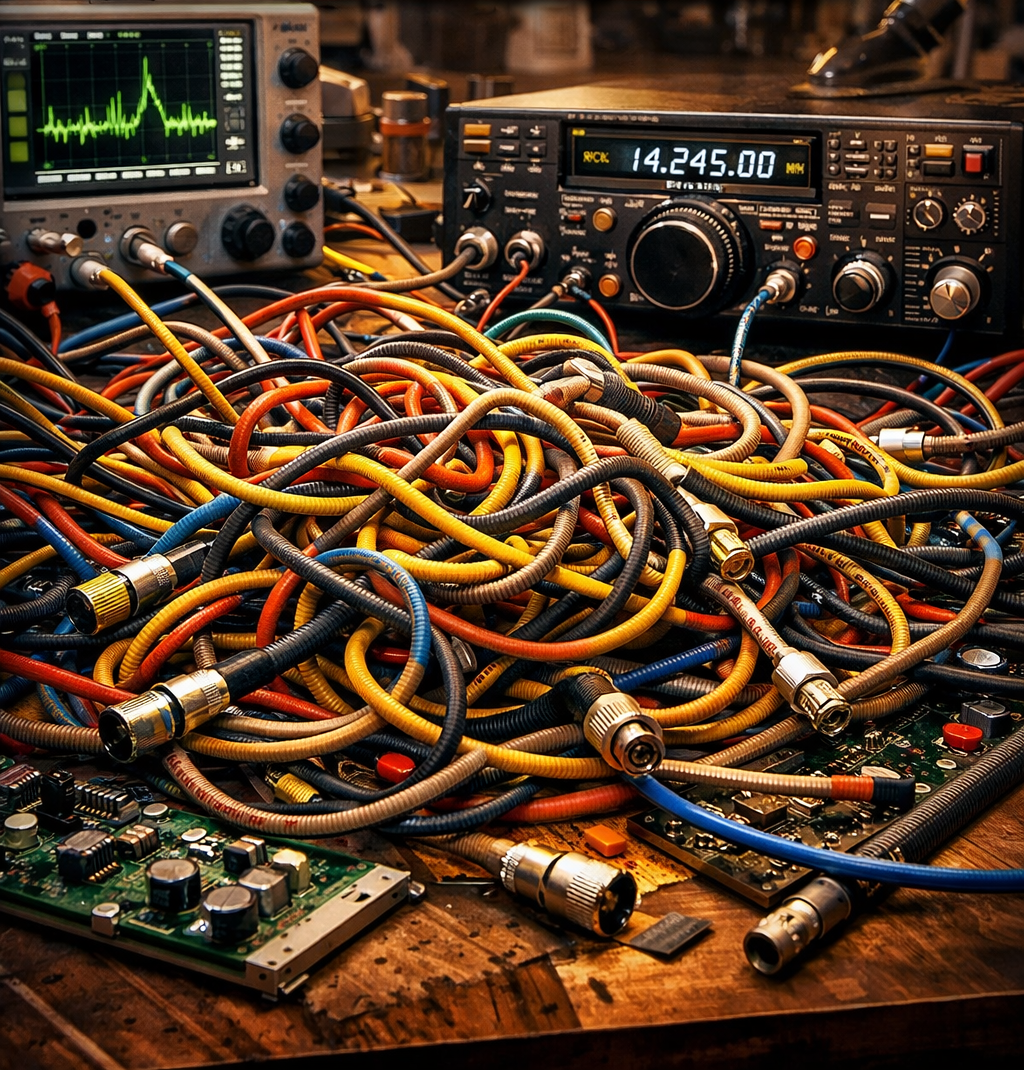
    Today, I took the image above and started questioning the spaghetti. Even with the probe point and little ground spring is it possible that I need the intended RFI shield (not installed) to deflect RF that could be interfering? Look at the 120v power cord for the 5v power supply (blue box). Check out the “long” I2C bus (black and white wires) over to the VFO/BFO. I’m lost today but … but I know for a fact that my LNA taught me one thing about RF that’s chiseled in my stone notebook. Bench testing has to be almost in its final, production-ready, RFI-shielded form. Is my radio build spaghetti the real problem here?

    I’ll end with another question. Should I re-flow the solder at my TCXO?

    Follow the Freedom7 Build

    I’m building a real HF SSB transceiver from the ground up – no kits, no shortcuts, and no hiding the hard parts.

    If you’re interested in how this system comes together over time, follow the full build here:
    https://kr4bad.com/category/the-build

    Not everything fits into a single build. For additional insights, experiments, and lessons learned:
    https://kr4bad.com/field-notes/

    Follow the build as it happens:
    https://kr4bad.com/?subscribe=1

    Looking for some background?
    https://kr4bad.com/about/

    Comments and discussion are always welcome:
    david [at] kr4bad-dot-com

    73,
    KR4BAD David
  • The Fun Part: VFO/BFO Assembly

    The Fun Part: VFO/BFO Assembly

    Project: Freedom7 HF Transceiver
    Component: VFO/BFO (Oscillators)
    Status: Assembly (Complete) … Testing begins (Apr 4, 2026)

    Update April 22, 2026: Complete PCB re-design. See below.

    March 24, 2026

    I just received my PCBs for my VFO/BFO oscillator factory component. I have all my parts. Now I need to sit at the bench and assemble this dude! Assembly baby!

    pcbs-baby

    I almost finished the assembly last night but I missed a resistor and one of my hand-wound coils came off the pad. The magnet wire came with clear enamel. I should have known to look for colored enamel magnet wire. I’ll go over the PCB closely before I begin testing for soldering errors or bridges over the small chip pads.

    I’m nervous about this one because the parts were expensive and the PCB was larger. I have 5 PCBs but still each part introduces the possibility of short or disconnection. The testing will take some time too.

    unfinished PCB

    3 points if you comment and tell me the part/component I forgot late last night.

    assembly

    I have completed the VFO/BFO, I think lol. I.e. I’ve attached every child component of this parent design and I’ve smoke-tested this new architectural component. I checked the voltage on my drop-down regulators (low-noise, high-quality) and they were not 3.3v.

    freedom7 vfo/bfo

    I think I was given instruction per datasheet to leave pin 7s floating. I cannot recall if this was 1) datasheet or 2) my AI partner. Pin 7 is an Enable (HIGH) and I specifically remember reading that the pin was held HIGH internally.

    I have two quality issues with this component and they are both specification issues in the PCB design. PCBWay has done a fantastic job with consistent quality however I am slowing my design with each and every design/drafting session in KiCad.

    If you notice in the image above, the terminal block seems misaligned. It is! I think the footprint and the actual terminal block are not correctly matched. The pins for the block are tiny and the pad holes too large. A mechanical engineering failure here has caused the pins to move beneath the terminal with several connect and disconnects of power to the component.

    The second quality issue is obviously the need to tie pin 6 (Vin) to pin 7 (enable) as you can see. I could have purposely created a solder bridge, and probably should have done that first, but I didn’t. Now I look at my creation and cringe. This and the terminal block foundations can be fixed with a PCB redesign.

    April 4, 2026

    Being the confident one, I decided I would begin the real testing with an Arduino sketch (C++) and a male SMA on coax to a BNC into my scope. What a disaster that was! I’m having deja vu now of testing an RF LNA on a white plastic breadboard lol.

    I began with the BFO because that’s to be a fixed 9 MHz to sit between the side bands. At the SMA (buffered and filtered), I could not get a stable or triggered response that would hold (cycle). I moved back to the Si5351a and still all over the place. To also add that when the frequency counter was even registering, the MHz varied between 40-60MHz. The first test should be to measure a solid reference clock at the TCXO feeding the Si5351a. Many DIY/Homebrew folks use the little breakout boards that come with the Si5351a. I wanted a little more stability for my VFO or the other output I’ll be discussing soon. For now, my BFO is a fixed frequency from an Si5351a with a TCXO reference 25 MHz.

    April 22, 2026

    I have made changes to my schematic and I am deep into a new PCB design. My testing has proven severe issues with my PCB design and I found High-Q inductors in 0805 packaging.

    I’m almost complete with the new design but I’m having other RF engineers review my design before we make, do another assembly, and test version 2. This has been an intensive exercise with lots of questions to be answered. Between discussions with different AI models, some reference books, and other people, I’m iterating with small changes and almost ready to give this another go.

    Here’s a draft of the new PCB.

    ver 2 PCB
    still under construction

    Follow the Freedom7 Build

    I’m building a real HF SSB transceiver from the ground up – no kits, no shortcuts, and no hiding the hard parts.

    If you’re interested in how this system comes together over time, follow the full build here:
    https://kr4bad.com/category/the-build

    Not everything fits into a single build. For additional insights, experiments, and lessons learned:
    https://kr4bad.com/field-notes/

    Follow the build as it happens:
    https://kr4bad.com/?subscribe=1

    Looking for some background?
    https://kr4bad.com/about/

    Comments and discussion are always welcome:
    david [at] kr4bad-dot-com

    73,
    KR4BAD David

  • AI Means Opportunity: Huge Improvement Gains in DIY Manufacturing

    AI Means Opportunity: Huge Improvement Gains in DIY Manufacturing

    This weekend, I’ve created 4 web applications using Claude.ai that are going to help me realize serious improvement gains in the manufacturing of a 7-band HF SSB Single-Conversion Superhet. The design, build, and test aspects of each component is the fun part. The difficulty comes when fighting gaps in cash flow and also waiting for materials or PCBs. Once components are identified, I normally do with what I have and work on what makes the most sense at the time. These applications help me see the state of things in a more informed way. When I have available time for this project, I will always have something to do even if I’m waiting on parts or PCBs.

    PartBin: Inventory Improvement and Awareness

    PartBin

    PartBin is the first application I created with the help of Claude.ai. I gave a clear paragraph of how I wanted an app that could record the individual parts I order and also track quantities (may be left over) and associate the parts with a specific modular component. This application uses local-storage (session) and also provided export/import of JSON files.

    The application is visually beautiful and this was also part of my prompting of Claude.ai. AI creates a single page HTML you can download. The web app was a serious improvement over sifting through cardboard boxes from Mouser.com. I started adding parts and exported my first backup JSON almost immediately after sent the index.html from my Mac Mini back to my bench machine (Intel NUC w/Ubuntu). I was floored with the HTML Claude.ai produced in about 3 minutes (180 seconds). I told my wife how excited I was. “That’s nice.”, she said.

    Component: Modular Architecture Improvement, Less the Diagram

    improvement

    When I began the Freedom7 project, I knew that the first radio wouldn’t be consumer-ready. It’s architecture would be like a component diagram where components were modular, i.e. the blocks defining the single-conversion SSB transceiver would need to stand on their own electronically. These components could be designed, built, and tested individually. The components could be improved over time. Enter the Component web app.

    I first created a functional requirements text file with clear specifics. I also provided data points that were important. I did another paragraph-sized prompt, describing what I wanted and keeping the style like PartBin. I attached the requirements.txt file and let Claude.ai do its thing. About 5 min later, it showed me the results of its effort. Beautiful!

    This was a second, immediate improvement. I now had a place for all components in a grid, visual status, and quick understanding of my work, very similar to a dashboard.

    I now have this app loaded with components and details for each. What you see in the image, is dummy data for the initial HTML creation. Please remember that AI remembers working with me and what I’m actually doing. This is paramount in pleasing it’s consumers.

    Projex: Task Management Improvement

    improvement

    Projex was the next to the last app I created, but my last app actually improves a dream and maybe not reality currently. Projex came about as something similar to Atlassian JIRA but my creation and one that I can refactor as I use it to track tasks across various projects.

    Again, the information in the image was generated by Claude.ai on it’s knowledge of what I’m doing. I prompted the creation of a task tracker but wanted the ability to also manage projects. I need the project and task administration because my time is limited and no one else is currently working with me.

    Projex is also my favorite application created this weekend. Like Component, I drafted a requirements.txt to go with the AI prompt. I have reference data in pull-downs but this data may change. Remember that the data can be backed up with an export of JSON.

    KitLab: Improvement Toward the Possibility of Sharing Component Kits

    improvement

    KitLab is not for now, but more of a visualization of what could be. The Low Noise Amplifier you see is an AI generation done with ChatGPT, “Can you make me an image suitable for presentation of a low noise amplifier that I made, image attached, and have it on a semi-dark background?”. ChatGPT did a good job, didn’t it? I made the 20 meter bandpass filter too. The data shown was part of the HTML generation by Claude.ai with the original prompt.

    KitLab helps me dream that I am closer to curating and selling RF component kits to people to learn about HF and why I did NOT choose the software-defined radio route. My work specifically chose the single-conversion superheterodyne radio for the fact that a DIY HAM radio enthusiast can actually make one of these at home with a little education.

    Follow the Freedom7 Build

    I’m building a real HF SSB transceiver from the ground up – no kits, no shortcuts, and no hiding the hard parts.

    If you’re interested in how this system comes together over time, follow the full build here:
    https://kr4bad.com/category/the-build

    Not everything fits into a single build. For additional insights, experiments, and lessons learned:
    https://kr4bad.com/field-notes/

    Follow the build as it happens:
    https://kr4bad.com/?subscribe=1

    Looking for some background?
    https://kr4bad.com/about/

    Comments and discussion are always welcome:
    david [at] kr4bad-dot-com

    73,
    KR4BAD David

  • DIY Today: Push Button PCB Ordering, Wow!

    DIY Today: Push Button PCB Ordering, Wow!

    My Early Fascination With Electronics

    When I was a child, I was obsessed with anything electrical and anything push button. I had a toy train transformer and would unravel fine copper wire to make tiny filaments that heated up and caught fire. My dad even helped me build a real electric motor on a piece of shelving board. The armature was a hard rubber ball with 16‑penny nails wrapped in copper magnet wire. We made brushes from a tin can using tin snips. We powered it with the train transformer. No push buttons yet — just pure DIY ingenuity.

    Building My First Radios

    I made a crystal radio with my grandfather that actually worked. Sitting on the bathroom floor in Portsmouth, Virginia, I heard a local AM station using an antenna wire out the window and a ground clipped to the sink drain. Later, I built more radios from kits. My grandfather took me to RadioShack often. I loved that place, but I always struggled with the connections between components — the “network” of the design.

    Learning Schematics and Early PCB Attempts

    I learned to read schematics before I ever went to college for electrical engineering. Kits were easy because the PCB was already made. But if you wanted to experiment, options were limited.

    My first breakthrough was using copper‑clad board and making large pads to hold components. It worked, but it wasn’t permanent or production‑ready.

    The next method was blocking traces with rub‑on stickers or a Sharpie and soaking the board in chemicals. Not exactly kid‑safe, and definitely not efficient.

    Life, Work, and Returning to DIY Electronics

    Eventually I grew up, went to college, changed schools, and ended up building nuclear submarines — doing piping system design for the Navy’s underwater fleet. Electronics took a back seat.

    Fast‑forward to today: I’m building a 7‑band HF transceiver from scratch. KiCad became my tool of choice for schematics and PCB layout. Each component lives in a private GitHub repo. After finishing a schematic, I open KiCad’s PCB editor and arrange the components. I’ll write more about that workflow soon.

    I design the PCB myself — DIM, not push button AI. When the PCB is complete, I generate Gerber and Drill files. These files define the exact requirements for manufacturing.

    From Old‑School Etching to Modern PCB Manufacturing

    This is a long way from sitting on the back porch with copper board, etching chemicals, and hand‑drawn traces. Today, you zip your Gerber and Drill files and send them to any PCB manufacturer.

    Enter Push‑Button PCB Ordering With PCBWay

    Since I use PCBWay as my PCB supplier, I discovered a new plugin for KiCad: PCBWay Plug‑In for KiCad

    This plugin changes everything.

    How the Push‑Button Workflow Works

    • The plugin adds a PCBWay icon to KiCad’s toolbar.
    • When your PCB is ready, you click the icon.
    • KiCad automatically uploads your Gerber and Drill files to PCBWay.
    • The PCB order page opens with everything pre‑loaded.
    • PCBWay recommends reviewing the files, but mine were perfect.

    It truly feels like push‑button PCB ordering. It is.

    Before the Plugin

    I used to:

    1. Export Gerber and Drill files manually
    2. Verify all files were present
    3. Zip them
    4. Upload the zip to PCBWay
    5. Validate the order

    Now it’s one click.

    Keeping Manufacturing Files in GitHub

    The plugin writes the files to the project directory, which is perfect — they get committed to Git and stored with the project. Clean, organized, and version‑controlled.

    Follow the Freedom7 Build

    I’m building a real HF SSB transceiver from the ground up – no kits, no shortcuts, and no hiding the hard parts.

    If you’re interested in how this system comes together over time, follow the full build here:
    https://kr4bad.com/category/the-build

    Not everything fits into a single build. For additional insights, experiments, and lessons learned:
    https://kr4bad.com/field-notes/

    Follow the build as it happens:
    https://kr4bad.com/?subscribe=1

    Looking for some background?
    https://kr4bad.com/about/

    Comments and discussion are always welcome:
    david [at] kr4bad-dot-com

    73,
    KR4BAD David

  • The Difficult, Brutal Reality of Building Anything from Scratch

    The Difficult, Brutal Reality of Building Anything from Scratch

    Enjoy those HAM radios, folks. Give thanks to all the radio manufacturers for the products you own and love. A lot of work goes into creating these modern wonders we call HAM radios. Many people don’t realize how difficult the original design is—just understanding how it works can be a challenge.

    I’m writing this post to share the ever‑so‑small blockers I’ve encountered since starting my Freedom7 HF Transceiver build. It sometimes feels like the universe doesn’t want me to complete this project. I say “universe” because I can’t pin the difficulty on any person, organization, or community. It’s been hard, my friends.

    Today I opened my mechanical pencil kit and started sketching a block diagram for my receiver chain. I’ve built a band‑pass selection stage and a low‑noise amplifier for the RF input of an AD831 mixer. I’ve nearly finished the design of my VFO/BFO Si5351A oscillator, clocked with a special temperature-compensated crystal oscillator (TCXO) from Epson/Seiko.

    I’ve also designed a low‑pass filter after the VFO, and I’m working on the BFR93A amplifier buffer that will sit between the VFO and the mixer.

    The most critical new component in my current design is the SSB crystal filter just after the mixer. I knew about it in passing, but not the details—not until today. Very difficult indeed.

    This journey has been difficult, to say the least. I’m being brutally honest because I will finish this, and I’m not going to hide the difficulty. I’ll celebrate my successes, but I’m also going to share the blockers. I want you, the reader, to know that even when facing a giant, I’ll crack him with my slingshot. My name is David, after all.

    As an IT architect, we use the term “blocker” in SCRUM meetings. Each person says: “This is what I did yesterday. This is what I’m doing today. And I either have a blocker or I have no blockers.” Throughout this article, I’ll describe my issues as blockers. A blocker is the thing preventing or slowing general progress, forcing you to stop and figure out what’s standing in your way.

    Comparing my lone HF transceiver build to work, I’ve had plenty of blockers. I’ll describe some past blockers and end with today’s blocker—the most difficult task so far.

    Somewhat Difficult

    When I began all this, I didn’t know KiCad. I was a draftsman a long time ago using IBM CADAM and various Intergraph tools. Everything I’ve made so far has been designed in KiCad and exported as Gerber/Drill files for PCB manufacture. That was my first blocker. I couldn’t just sit down and draw my band‑pass filters; I had to learn enough KiCad to be dangerous. I did. Blocker overcome.

    The next blocker was designing and manufacturing band‑pass filters that didn’t test within acceptable limits. This was the beginning of iterative design in this project. I know all about iteration in the IT world, but I thought careful work, double‑checking, and attention to detail would produce a perfect product. No, lol. Back to the woodshed for better design.

    Since I’m doing RF work with all kinds of waveforms, I knew I’d need an oscilloscope and a signal generator. That was another blocker—investing in more tools. I got what I needed. Not top‑shelf, but enough to move forward.

    Most Difficult

    I planned to design around a tiny transistor called the BFR93A to create a low‑noise amplifier for the weak RF signal from the antenna. Before manufacturing a PCB, I gathered radial components—not SMD—and built a breadboard prototype to scope the output. What a disaster.

    I soldered three clipped resistor leads onto a BFR93A SMD transistor so I could plug it into the breadboard. I chose the rest of the parts from what I had on hand and built the entire amp on the breadboard. You should have seen the output on the scope when I fed it 12 volts as designed. It looked like an EKG trace from a hospital monitor. Maybe there was a hint of a sine wave in there somewhere.

    I created three designs on paper for the LNA. Lots of blockers along the way. After modeling and testing on the computer, I designed the PCB and included pads for Harwin RFI clips. These clips will let me build a small sheet‑metal can to shield the circuit from interference.

    RFI clips

    RF problems with the breadboard version weren’t the first blocker for the LNA. The next blocker—shorter but just as frustrating—came during testing. I set each band center to receive a 500 mV sine wave, took my measurements, and stared at the scope in disbelief. After all that work, after ordering the PCB, I was now looking at disastrous results. Not only did I not get the gain I needed, the output was distorted and compressed beyond use. Progress stopped cold.

    I stepped away, took a breath, and thought it through. Blocker removed. I had been testing with half a volt—500 mV, 0.5 V. I don’t know of a single antenna delivering a 0.5‑volt RF signal. I went back to the bench, dropped the input to 1 mV, and tried again. Et voilà. Everything came alive. The gain was perfect, and the signal was clean—no visible noise. And this was before adding the shield can. I built the can afterward.

    I have an AD831 mixer and a full control setup using an Arduino Mega 2560 with I2C for the VFO/BFO. The VFO/BFO design and everything upstream—voltage regulators, a stable clock oscillator—are complete. I’m building a single VFO/BFO module with two SMA outputs, one for each signal. Both outputs need filtering before the SMAs. The VFO filter is done and caps the bandwidth around 35 MHz. The BFO filter is still unknown territory because I don’t fully understand its requirements yet. That’s my current blocker for the VFO/BFO module, and it will resolve as I continue refining the receiver‑chain architecture.

    As I moved to the IF side of the mixer, I hit the next major component—the most sensitive part of any SSB receiver: the SSB crystal filter, also known as a ladder filter. I had this vision that I was close to a working receiver. I had climbed the low‑noise amplifier mountain and survived. Then—bam. The SSB crystal filter appeared like a boss fight. It practically said, “Oh, you thought you were smart? You conquered that sensitive, high‑gain LNA? Cute. Here’s your next challenge.”

    Extremely Difficult

    CoPilot told me I should buy the first SSB crystal filter because it’s extremely complex to design. It also warned that finding one in 2026 would be difficult. That made me pause. What does that even mean? The alternative is building one myself—but that requires more tools, more knowledge, and more precision.

    I can buy a batch of 50 crystals, but I’ll need to test and match six of them for the final filter. I’ll need specialized software to calculate the supporting components and design the ladder network. It’s doable, but it’s a serious undertaking.

    Current Status

    I’ll write another posting soon that will describe my solution to this blocker. And, I do need to learn about the BFO and how I can add a harmonic filter to it’s output like the VFO. Will I need a buffer amplifier there too? I think the answer is yes.

    Follow the Freedom7 Build

    I’m building a real HF SSB transceiver from the ground up – no kits, no shortcuts, and no hiding the hard parts.

    If you’re interested in how this system comes together over time, follow the full build here:
    https://kr4bad.com/category/the-build

    Not everything fits into a single build. For additional insights, experiments, and lessons learned:
    https://kr4bad.com/field-notes/

    Follow the build as it happens:
    https://kr4bad.com/?subscribe=1

    Looking for some background?
    https://kr4bad.com/about/

    Comments and discussion are always welcome:
    david [at] kr4bad-dot-com

    73,
    KR4BAD David

  • Good News from the Shack: Feb 2026

    Good News from the Shack: Feb 2026

    KR4BAD’s Operating Saga

    Problem

    While I’m building my own Freedom7 HF Transceiver at the bench or in the shack, I’m also a HAM operator. I love both HF and 2 meter. I renewed my old HAM license KJ4GIZ with KR4BAD. I’m not the bad guy but I do find that my new call is memorable. People talk about it, make mention of the BAD part.

    KR4BAD

    My operator problem is the huge expense all over again and based on my interests. I like 2 meter and HF. So I needed new radios. The VHF/UHF one I had was terrible and has something wrong with it. It was 25 watts but I don’t think it was pushing anything near that. What would I get? And, when?

    I wanted to do POTA hunting as soon as possible because I could sit on the front porch, weather permitting, and log QSOs with people at US parks.

    I bought a couple Baofeng HTs and gave one to my oldest son. He likes to listen while he doesn’t study for his ticket. That’s a problem for another day.

    The HF problem was CW vs. SSB. I had a couple of CW-only radios by TenTec but nothing to do single side band (SSB). And, I could only remember CQ on the key. That’s it. I now needed to find an economical solution for an HF radio, preferably something I could take on a POTA activation.

    That would be my problem(s). I needed a solid 2-meter radio to talk with my repeater friends and a decent HF radio for phone work.

    Early Success

    The glimmer of success came for me by building my own 2-meter ground plane with 5 heavy copper wires and a SO-239 cabinet mount connector. I was able to mount it on a microphone stand that I’ll discuss later. A short coax and I could sit in a chair using my Baofengs in the living room or my shack.

    My HF radio was then just a discussion with a friend that got a Xiegu G90 from AliExpress or Alibaba. The G90 was 20W but would do HF with CW, Data, and SSB (Phone). And, at 20W I could do LiFePO4 batteries and not need a power supply. Now I save my money.

    I later went to the RARSFest at the NC state fairgrounds and got an iCom IC-208H VHF/UHF dual-band mobile radio. That would get me on the air with my friends. And, my 12AH LiFePO4 battery would run this rig for several days when I was checking in on evening nets. I also used that microphone stand, I spoke about earlier, to install a new J-Pole I purchased from KB9VBR.

    I finally had the cash to purchase a Xiegu G90 and also put a 10-40 meter long wire (EFHW) in the pine trees in my front yard. I was a technician class then and did 10 meter a bunch. I’m now general and do more but usually it’s 10-40 SSB and 10-40 FT4/FT8 (Data).

    Setback

    I offered to be net control for the Sunday night JARS net on 147.270, My iCom IC-208H was going to go dead on me mid-net at some point if I didn’t order a power supply or find another solution for my hosting the net. My Freedom7 radio is my monthly budget and I’ve been pushing hard to get the receive side working. No ready cash and an obligation to do this presented a problem.

    My second setback was the purchase of a Yaesu FT-990 100 watt HF rig from a friend in my radio club. He was selling it for the wife of a deceased friend (silent key). I can’t test it really on my good antenna but I’ve tried it and made contacts using a portable vertical, the JPC-12. I didn’t realize at this time that the VFOs had drifted and were inaccurate.

    Crisis

    I’ve actually had two crisis situations this month. First, the FT-990 should be repairable and I attempted the repair with no luck at all. I found someone semi-local to work on it but he said he didn’t know how to work on radios in that time boxing … around 1994. It was like my having a 100 watt HF rig wasn’t going to happen.

    I thought I had a charged up battery and had been using my iCom mobile successfully as a base station when one of the HAM legends pitched in the net with “comment” and proceeded to tell me my audio sucked and here’s how to fix it. Bummer, because my radio didn’t have these tweaks. I basically didn’t sound like a radio announcer or the other loud mouths in the group. I’m generally somewhat quiet but now I need a real voice in the shack.

    Recovery

    Time to kill two birds with one stone. My friend John, KM4JB has a Yaesu FT-991a and guess what it does? It’s a shack in the box so to speak. It does UHF/VHF and HF. I’m broke now but I solved both problems. Last night I did 100 FT-8 contacts from around the world on 40 meters. And, after John sent me settings for the microphone equalizers, I’m sounding like your local country music announcer on FM radio while sitting in my humble shack. I have peaked the summit.

    shack in a box

    Better Place

    Am I in a better place all around as a HAM radio operator? You bet I am! I now have a radio that does it all and I can say that I have proper tools. I had to purchase a power supply for the radio and also increase the rating on my EFHW. I replaced the unun and increased the wire gauge (14 AWG). I am also finding my voice within the JARS club and on the radio.

    My About page provides the background of the Freedom7 HF Transceiver project.

    If this story resonates, comments are welcome. You can also reach me at david [at] kr4bad-dot-communications. no com.

    And if you believe understanding our radios matters more than sealed boxes, you can subscribe here:
    https://kr4bad.com/?subscribe=1

    73
    KR4BAD
    David

    Why This Article Uses the “No Easy Way” Story Model

    This post follows the No Easy Way structure from Steve Rawling’s Pipdeck Storyteller Tactics:

    1. Problem — New license, no radios
    2. Early Success — Baofengs, some coat-hanger wire antenna, and a Xiegu G90
    3. Setback — Weak operations and no real shack environment
    4. Crisis — Purchased 100W radio is not working and my 2-meter broadcasting is weak at best
    5. Recovery — New Yaesu FT-991a
    6. Better Place — Finding my place within the JARS club and my voice on the radio

    The climb isn’t finished — but HAM life moves higher up the mountain.

  • Good News from the Bench: Feb 2026

    Good News from the Bench: Feb 2026

    The Freedom7 HF Transceiver Saga

    Problem – Starting the Climb

    This maker has decided to prepare a comprehensive posting each month, to journal the progress of my Freedom7 Transceiver at the bench. I am also doing one called, “News from the Shack” as well.

    The goal is simple, but not easy: build something real, understand it deeply, and share the lessons along the way — including the mistakes. This month’s focus has been the receive-chain, specifically a low-noise amplifier (LNA) and revisiting my band-pass filters.

    Nothing about this process has been straightforward. Designs change. Assumptions fail. And every step forward seems to reveal two more things that need attention.


    Early Success — Momentum Builds

    This month I completed the design, assembled the components, and tested a low-noise amplifier at the bench. I think the design changed about three times, and while I support fast failures, I now have a working LNA.

    low-noise amplifier

    I also returned to the band-pass filter(s) and redesigned them on paper as Butterworth modeled 3-pole, series-coupled textbook filters. My choice of components leaned toward larger air-core inductors with high-Q values. The capacitors were carefully selected as well, and two had to grow beyond the 0805 packaging because I couldn’t get the values I needed due to dielectric material limitations. I forget the exact package, but it was basically the next size up physically. I’ll achieve my maker title soon I’m sure.

    On paper — and even in simulation — things were starting to look good.


    Setback — When Reality Pushes Back

    Lessons learned always come from mistakes, and I plan to document the detailed LNA design in another posting. I’ll say here that the design leaned heavily on reference material: books, PDFs, posts, AI, and anything online I could get my hands on.

    The overall design was modeled using LTSpice over several iterations. Change something, simulate again, refactor, repeat. LTSpice is a great tool for initial design, and eventually I had results that looked promising.

    That’s when I made the classic assumption:

    “I’m ready for the breadboard.”

    Wrong.


    Crisis — Under the Big Top

    My attempt at a breadboard solution was an utter joke.

    When I connected my scope, I wasn’t looking at a clean RF design — I was under the big top at the circus that just came to town. Noise everywhere, instability, and behavior that simulation never warned me about.

    That moment forced a realization:

    This design would have to be tested in its final form — on an actual PCB, possibly with an RFI shield — not floating on a breadboard, with parasitic capacitance, and with an array of jumper wires (little antennas) like some classroom experiment.

    It was a humbling checkpoint. And, now I know, “don’t do that!”


    Recovery — Iteration Becomes the Way Forward

    The band-pass filters went through multiple iterations, both on paper and PCB. The LNA followed the same path. One clear solution moving forward is to embrace the iterative mantra:

    Design. Build. Test. Refactor. Repeat.

    Simulation gets you started. Reality teaches the lesson.

    My next component will be a very stable and accurate variable frequency oscillator (VFO), or local oscillator, slated for March. I have the start of a schematic and have identified an extremely stable and low-noise square-wave solution using a more expensive chip than the common Si5351a many hobbyists use.

    This part of the climb feels different — less guessing, more informed decisions.


    Better Place — Higher on the Mountain

    Each month’s progress brings me closer to something bigger than just a radio. This journey is about understanding, building, and hopefully inspiring others to step away from black boxes and toward real RF knowledge.

    Stay tuned and come back, y’all.

    Please check back periodically and watch my progress here. I welcome WordPress subscribers. I’m doing this for myself, yes — but also to spark interest and hopefully influence younger generations to become Makers too.

    My About page provides the background of the Freedom7 HF Transceiver project.

    If this story resonates, comments are welcome. You can also reach me at david [at] kr4bad-dot-communications. no com.

    And if you believe understanding our radios matters more than sealed boxes, you can subscribe here:
    https://kr4bad.com/?subscribe=1

    73
    KR4BAD
    David


    Why This Article Uses the “No Easy Way” Story Model

    This post follows the No Easy Way structure from Steve Rawling’s Pipdeck Storyteller Tactics:

    1. Problem — Beginning a complex RF journey with no shortcuts
    2. Early Success — Working designs and encouraging simulations
    3. Setback — Breadboard assumptions fail
    4. Crisis — The “circus” moment on the oscilloscope
    5. Recovery — Iterative engineering becomes the method
    6. Better Place — Greater understanding and forward momentum

    The climb isn’t finished — but each iteration moves higher up the mountain.


  • Support Your Children’s Curiosity: An Insider Message to Parents, Makers, and Future Engineers

    Support Your Children’s Curiosity: An Insider Message to Parents, Makers, and Future Engineers

    Curiosity is one of the most powerful forces in a child’s life. I know this because I still carry the same spark I had when I was young. Nearing the end of my career, my curiosity, experimentation, and radio pastime are only growing stronger. As a mentor and elmer to engineers at work—and as an active member of the Johnston County Amateur Radio Society (JARS)—I feel a deep responsibility to help ignite that same spark in others.

    This article is for every parent, grandparent, or guardian who sees that glimmer of curiosity in a child and wonders how to nurture it.

    The Childhood Moments That Shape a Lifetime

    When I hear parents talk about their kids wanting to tinker with electronics, tools, or radios, I light up. It takes me right back to my own childhood.

    I spent many weekends with my grandparents in Portsmouth, VA. My grandfather worked as a black‑powder compressor for the U.S. government, and his workshop was a wonderland to me. He had enormous artillery rounds (which I simply called “big bullets”), guitars, a HAM radio the size of a suitcase, and an oscilloscope that looked like a portal into another universe.

    I was captivated.

    As I grew into an adult, I had become a guitarist at age four, developed a fascination with rockets, projectiles, and firearm engineering. I built my first crystal radio at age six. Those early experiences shaped everything that came after.

    Why Curiosity Matters More Than Ever

    Because I remember that feeling so vividly, I want nothing more than to hand every curious child an Erector Set, a microscope, a chemistry kit, a Rock‑Chucker press, or a Heathkit radio and say, “Go explore!”

    I raised two smart, capable boys who grew up in a different world—one filled with constant digital stimulation. They loved their X‑Box (I’ll spare you the link), and while they were curious in their own ways, they didn’t have the same drive to take things apart and understand how they worked. I had to entertain myself; they had entertainment delivered to them.

    That difference matters.

    Today’s kids have access to technology I couldn’t even dream of. With the right guidance, a curious child could become the next great engineer, inventor, or scientist. But only if we let them explore.

    Please Don’t Punish Curiosity—Guide It

    If your child finds a screwdriver and takes apart something important, don’t punish them. That moment is a gift. It means their mind is reaching, stretching, trying to understand the world.

    Instead:

    • Give them something safe to take apart.
    • Provide tools and show them how to use them.
    • Let them be part of your hobbies.
    • Encourage questions—even the ones that slow you down.

    I failed at this when my boys were young. I had two worlds: my demanding 60‑hour workweek and my hobbies. When they asked, “What are you doing, Dad?” I often sent them away because I wanted my quiet time. I regret that. I wish I had invited them in.

    A Different Kind of Child Needs a Different Kind of Support

    Some children think differently. They look at a Dyson vacuum and wonder how the cyclone works. They stare at a radio and imagine the invisible waves. They see a circuit board and feel a pull toward understanding.

    These kids aren’t “breaking things.” They’re learning.

    And they need adults who recognize that spark.

    I can’t buy every child an oscilloscope or a soldering station. But I can share this message in hopes that it reaches the parents who need to hear it.

    Imagine the Possibilities

    If I had access to today’s technology as a child, I would have been unstoppable. Not because I’m special, but because the tools would have matched the intensity of my curiosity. I wasn’t a bad student—I was a bored one. My grades suffered not from lack of intelligence, but from lack of engagement.

    My oldest once said, “Why do I have to show my math work? I know how to do it. And the teacher knows how to do it.” That stubborn streak? That was me. It was in the DNA.

    Curious kids don’t always fit neatly into the classroom. But they thrive when given room to explore.

    Final Thoughts: Nurture the Spark

    If you’re a parent with a curious child, you have an opportunity that can shape their entire life. Support their experiments. Encourage their questions. Let them take things apart. Let them build things that don’t work. Let them fail and try again.

    Curiosity is a gift. And the world needs more people who never lose it.

    DISCLAIMER: I’ve given here what I’ve categorized as Wisdom on my WordPress article. I’ve talked about pressing gunpowder to taking apart an electrical appliance. In no way am I proposing dangerous or harmful behavior but I do think we should cover our children with a helmet and knee pads, share safety, and safe behavior. E.g. my boys got A’s on their gun safety test after training. You are the parent here, not me. I’m just sharing possibilities for that next Thomas Edison, Galileo, Marconi, Benjamin Franklin, etc.

    My About page provides the background of my project, the Freedom7 HF Transceiver.

    If this story resonates, comments are welcome. You can also reach me at david [at] kr4bad-dot-communications. no com

    And if you believe understanding our radio matters more than black boxes, you can subscribe to my WordPress https://kr4bad.com/?subscribe=1.

    73 KR4BAD David

  • The Lost Art of Understanding Our Radios

    The Lost Art of Understanding Our Radios

    The Bad Place: Before the Radio Theory was known by Operators

    At the dawn of the 20th century, radio was mysterious, fragile, and poorly understood. Communication over distance relied on cables, messengers, and guesswork. Early wireless systems were unstable, interference-prone, and often unreliable.

    Radio existed, but understanding our radio would take a while.

    This was the bad place: a world that knew radio was powerful, but didn’t yet understand how to control it, refine it, or trust it.


    Pride: Mastery Through Hands-On Radio

    understanding our radio

    Following World War I—and through the rise of the British Empire’s global communications network—radio entered a golden age of understanding.

    By the early 20th century, radio was no longer confined to governments and industry. It became a technology that individuals could build, modify, repair, and improve—often with parts and knowledge they acquired themselves.

    In the United States especially, amateurs were:

    • Winding coils by hand
    • Building transmitters from discrete components
    • Repairing receivers at home or in the field
    • Understanding circuits because they had to

    Radios were not sealed products; they were instruments. Accessories, antennas, tuners, and power supplies were designed, shared, and iterated on locally.

    This was a time of justified pride:

    • Pride in skill
    • Pride in understanding
    • Pride in independence

    Amateur radio wasn’t about owning technology. It was about knowing it.


    The Warning: Convenience Replaces Curiosity

    As decades passed, radios improved rapidly. Reliability increased. Miniaturization accelerated. Eventually, radios became consumer products.

    The warning signs were subtle:

    • Schematics became harder to obtain
    • Repairs shifted from component-level to board replacement
    • Surface-mount parts replaced accessible through-hole designs
    • Firmware replaced circuits

    The hobby didn’t collapse—but something quietly changed.

    Understanding became optional.

    As long as the radio worked, curiosity was no longer required.


    The Fall: When Repair Leaves the Community

    understanding our radio

    The fall didn’t happen all at once. It happened when radios stopped being repairable by their owners.

    Today, a large percentage of amateur radio operators can no longer work on their own equipment—not because they lack intelligence, but because the ecosystem no longer supports it.

    I live in a region dense with technical talent and higher education—multiple colleges, engineering programs, and skilled professionals. Yet when my 1994 Yaesu HF transceiver failed, the prevailing advice wasn’t local troubleshooting or schematic analysis.

    It was:
    “Send it to a repair shop in Florida.”

    A decades-old amateur radio.
    Shipped across the country.
    Because no one nearby could fix it.

    That moment marks the fall.


    The Worse Place: Where We Are Now

    This is the worse place—and it’s where we are today.

    Modern amateur radio is dominated by extraordinary equipment designed by companies like Yaesu, Icom, and Kenwood—companies that hold decades of accumulated HF intellectual property. Understanding our radio or anyone else’s for that matter is pipe-dream.

    The radios are brilliant.
    The performance is stunning.
    The knowledge is sealed away.

    Much of the global East now creates and maintains the understanding, while most of the U.S. amateur community just consumes the results.

    We buy the radios.
    We compare features.
    We are satisfied—as long as they work.

    But when they don’t, the answer is no longer “Let’s fix it.”
    The answer is “Where do we get it fixed?”

    Like every other consumer electronic device, we buy another one. This doesn’t feel right.

    That is not where amateur radio began—and it is not where it thrives.


    Why This Matters to Clubs and the Future

    At Johnston Amateur Radio Society, like many clubs across the country, we’re focused on membership growth and engaging new operators.

    Younger, technically curious people want more than polished tools. They want to be captured by the technology.

    • To understand how our radios work
    • To trace signals
    • To be able to repair what breaks
    • To customize and build what doesn’t exist

    Remember the Erector Set? Radios don’t engage this kind of behavior today. What they do is put a seal on the enclosure and tell you your warranty will be voided if you break it.

    If amateur radio becomes only an appliance hobby, it loses the very spark that once made it revolutionary.


    My Goal: Reversing the Arc

    With my HF SSB radio project, I’m not trying to recreate the entire body of global RF knowledge. That would be unrealistic.

    What I am trying to do is interrupt the fall:

    • Bring schematics back into the conversation
    • Treat RF as something understandable, not mystical
    • Talk about models, stability, noise, and tradeoffs
    • Encourage building, not just buying

    If we can reclaim even part of this understanding locally, repairability—and pride—returns with it.


    Why This Article Uses the “Pride and Fall” Story Model

    This article follows the Pride and Fall narrative structure described in Storyteller Tactics by Steve Rawling (Pipdecks):

    Bad Place – Radio existed but wasn’t understood

    Pride – Mastery through hands-on experimentation (1918–1939)

    Warning – Convenience quietly replaces understanding

    Fall – Operators lose the ability to repair their own tools

    Worse Place – We rely on distant experts and sealed knowledge

    This structure matters because it mirrors reality:
    Progress without participation doesn’t lead upward—it leads outward, away from us.

    Understanding our radios is not nostalgia.
    It’s the foundation of resilience.

    And amateur radio deserves to stand on it again.


    My About page provides the background of my project, the Freedom7 HF Transceiver.

    If this story resonates, comments are welcome. You can also reach me at david [at] kr4bad-dot-communications. no com

    And if you believe understanding our radio matters more than black boxes, you can subscribe to my WordPress https://kr4bad.com/?subscribe=1.

    73 KR4BAD David

  • Mouser Electronics: This Week’s Top Component Supplier

    Mouser Electronics: This Week’s Top Component Supplier

    (Why sourcing matters as much as schematics)

    In any electronics project—especially one that lives somewhere between hobby and future product—the choice of component supplier quietly shapes everything that follows. Availability determines design flexibility. Documentation determines confidence. Packaging and models determine how fast an idea moves from schematic to board.

    This week, I want to highlight Mouser Electronics as the primary component supplier I’m using for my current build, and explain why that choice matters at the bench level.

    This isn’t a sponsorship. It’s a practical acknowledgment of how modern projects get built.


    Selection That Enables Design (Not the Other Way Around)

    One of Mouser’s strongest advantages is breadth—not just the number of parts, but the depth within each category. When you’re designing RF, analog, or mixed-signal circuitry, being able to compare multiple manufacturers’ parts side-by-side matters.

    It means you can:

    • Adjust a design based on availability without starting over
    • Compare electrical characteristics, not just price
    • Avoid single-source dependencies early in a project

    For small-scale builds, that flexibility is often the difference between continuing momentum and redesign fatigue.


    Packaging Options That Respect the Builder

    Not every project starts as a production run. Mouser’s packaging options—cut tape, reels, trays, and small quantities—support that reality.

    That matters because:

    • Prototyping doesn’t require bulk commitments
    • You can validate a design before scaling
    • You’re not forced into unnecessary inventory cost early

    It’s a small thing on paper, but at the bench it keeps experimentation affordable and sane.


    Datasheets That Are Easy to Find—and Easy to Trust

    Datasheets are not optional reading. They’re part of the design process.

    Mouser’s part landing pages consistently surface:

    • Manufacturer datasheets (usually the latest revision)
    • Key electrical specifications at a glance
    • Environmental and compliance information
    • Lifecycle status (active, NRND, obsolete)

    That saves time—and more importantly—reduces guesswork. When you’re validating operating limits or margin assumptions, having authoritative documentation one click away changes how confidently you design.


    Parametric Search That Actually Works

    Good parametric search isn’t about filters—it’s about decision-making.

    Mouser’s filters allow you to narrow parts by:

    • Voltage, current, tolerance, temperature
    • Package type and mounting style
    • Manufacturer and lifecycle status

    This is especially useful when you’re designing under constraints imposed by cost, availability, or shipping considerations. It lets the design adapt to reality instead of fighting it.


    Simulation and Footprint Models: Optional, but Powerful

    While I’m currently using LTspice without vendor-specific component models, Mouser’s aggregation of simulation resources is worth noting.

    For many components, Mouser links to:

    • SPICE or LTspice models (when provided by the manufacturer)
    • Manufacturer-supplied reference designs
    • In some cases, PCB footprint or pad layout data suitable for tools like KiCad

    Even when you don’t use these models directly, their availability adds confidence. It means the component ecosystem around a part is mature, documented, and supported.

    As the project evolves, those resources become increasingly valuable.


    Why This Matters for Small Projects

    Large organizations absorb sourcing friction through scale. Small builders don’t have that luxury.

    A supplier that:

    • Presents clear specs
    • Supports small quantities
    • Aggregates documentation
    • Maintains predictable fulfillment

    …becomes part of the engineering workflow itself.

    That’s why Mouser fits well into this stage of my project. It supports exploration without forcing premature decisions about volume, vendor lock-in, or long-term commitments.


    Final Thought

    Choosing a component supplier isn’t about loyalty. It’s about alignment with how you build right now.

    This project is still evolving. Designs will change. Constraints will shift. But having a supplier that reduces uncertainty—rather than adding to it—keeps the work moving forward.

    This week, that supplier is Mouser Electronics.


    My About page provides the background of my project, the Freedom7 HF Transceiver.

    If this story resonates, comments are welcome. You can also reach me at david [at] kr4bad-dot-communications. no com

    And if you believe understanding matters more than black boxes, you can subscribe to my WordPress https://kr4bad.com/?subscribe=1.

    73 KR4BAD David