I’m a digital guy, i.e. my background is digital chips, logic ICs, microprocessors, microcontrollers, and such. I actually began this radio build with concepts of control and display, hence the use of two, yes I said, “Two.” Arduino Mega 2560 microcontrollers. I’ll be using two serial lines, send and receive to my Display microcontroller and I’ll use two low frequency lines for the I2C bus. I think that’s the extent of any control lines susceptible to any RF interference, or am I wrong?
Radio Build Status
What’s wrong with this circuit? Why can’t I get a steady state 9MHz from my BFO in the Chinese food tray? I can’t figure it out. This article is categorized as Build Notes and Lab Notes. This is an explanation and insight article for my HAM radio friend, K9MDR.
I am going to first provide the status for my latest component, I lovingly call in my KiCad schematic “Solid VFO/BFO”. This component is assembled on the unused PCB you see in the image in front of my engineering desk pad. This component, in the Chinese food tray, is powered and controlled by an I2C bus (black and white wires).
Radio Build Testing
When powered, a single Arduino Mega 2560 runs a test sketch (C++) that initializes an Si5351a via the I2C bus, turns off CLK0 and CLK2, turns on CLK1 (second output) and tells the chip to send a 9 MHz wave for use with the second mixer in my SSB HF transceiver build.
I currently cannot validate a 9 MHz wave on CLK1 at the si5351a. I can however, produce a 1.51 MHz square wave using a configuration that expects a 1 MHz output. AI was suggesting that Mouser sent me a TCXO that was labeled incorrectly as 25 MHz. I couldn’t prove what the output is exactly. I suspect that this oscillator is not working correctly.
So begins the haunting. I cannot validate the reference frequency. It’s doing something but can’t seem to trigger my scope correctly. My frequency counter on the TCXO wavers wildly up to 60+ MHz. Setting BW 20 to off (would add a Low Pass filter) did not even allow any signal to be triggered, harmonic or otherwise. Let’s see, what else? Tested the 3 used pads for the TCXO. Ground was ground. Vcc was 3.3V. And, the output was doing something, I think calling SPACE on Echolink.
AI left me at 1:00 AM last night with the suggestion to send my own, known signal, as a reference to the Si5351a. I’ve thought about this but haven’t done any more than think about it.
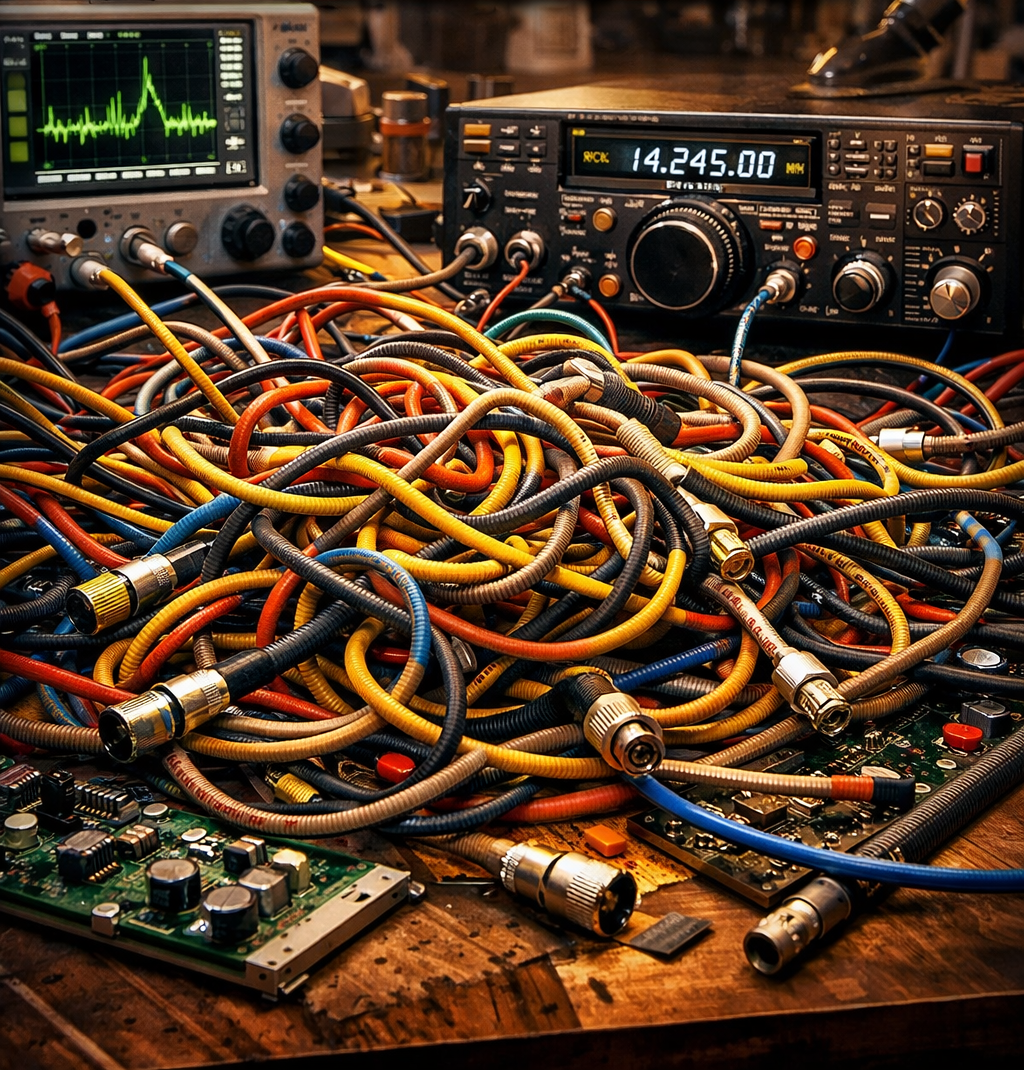
Today, I took the image above and started questioning the spaghetti. Even with the probe point and little ground spring is it possible that I need the intended RFI shield (not installed) to deflect RF that could be interfering? Look at the 120v power cord for the 5v power supply (blue box). Check out the “long” I2C bus (black and white wires) over to the VFO/BFO. I’m lost today but … but I know for a fact that my LNA taught me one thing about RF that’s chiseled in my stone notebook. Bench testing has to be almost in its final, production-ready, RFI-shielded form. Is my radio build spaghetti the real problem here?
I’ll end with another question. Should I re-flow the solder at my TCXO?
Follow the Freedom7 Build
I’m building a real HF SSB transceiver from the ground up – no kits, no shortcuts, and no hiding the hard parts.
This weekend, I’ve created 4 web applications using Claude.ai that are going to help me realize serious improvement gains in the manufacturing of a 7-band HF SSB Single-Conversion Superhet. The design, build, and test aspects of each component is the fun part. The difficulty comes when fighting gaps in cash flow and also waiting for materials or PCBs. Once components are identified, I normally do with what I have and work on what makes the most sense at the time. These applications help me see the state of things in a more informed way. When I have available time for this project, I will always have something to do even if I’m waiting on parts or PCBs.
PartBin: Inventory Improvement and Awareness
PartBin is the first application I created with the help of Claude.ai. I gave a clear paragraph of how I wanted an app that could record the individual parts I order and also track quantities (may be left over) and associate the parts with a specific modular component. This application uses local-storage (session) and also provided export/import of JSON files.
The application is visually beautiful and this was also part of my prompting of Claude.ai. AI creates a single page HTML you can download. The web app was a serious improvement over sifting through cardboard boxes from Mouser.com. I started adding parts and exported my first backup JSON almost immediately after sent the index.html from my Mac Mini back to my bench machine (Intel NUC w/Ubuntu). I was floored with the HTML Claude.ai produced in about 3 minutes (180 seconds). I told my wife how excited I was. “That’s nice.”, she said.
Component: Modular Architecture Improvement, Less the Diagram
When I began the Freedom7 project, I knew that the first radio wouldn’t be consumer-ready. It’s architecture would be like a component diagram where components were modular, i.e. the blocks defining the single-conversion SSB transceiver would need to stand on their own electronically. These components could be designed, built, and tested individually. The components could be improved over time. Enter the Component web app.
I first created a functional requirements text file with clear specifics. I also provided data points that were important. I did another paragraph-sized prompt, describing what I wanted and keeping the style like PartBin. I attached the requirements.txt file and let Claude.ai do its thing. About 5 min later, it showed me the results of its effort. Beautiful!
This was a second, immediate improvement. I now had a place for all components in a grid, visual status, and quick understanding of my work, very similar to a dashboard.
I now have this app loaded with components and details for each. What you see in the image, is dummy data for the initial HTML creation. Please remember that AI remembers working with me and what I’m actually doing. This is paramount in pleasing it’s consumers.
Projex: Task Management Improvement
Projex was the next to the last app I created, but my last app actually improves a dream and maybe not reality currently. Projex came about as something similar to Atlassian JIRA but my creation and one that I can refactor as I use it to track tasks across various projects.
Again, the information in the image was generated by Claude.ai on it’s knowledge of what I’m doing. I prompted the creation of a task tracker but wanted the ability to also manage projects. I need the project and task administration because my time is limited and no one else is currently working with me.
Projex is also my favorite application created this weekend. Like Component, I drafted a requirements.txt to go with the AI prompt. I have reference data in pull-downs but this data may change. Remember that the data can be backed up with an export of JSON.
KitLab: Improvement Toward the Possibility of Sharing Component Kits
KitLab is not for now, but more of a visualization of what could be. The Low Noise Amplifier you see is an AI generation done with ChatGPT, “Can you make me an image suitable for presentation of a low noise amplifier that I made, image attached, and have it on a semi-dark background?”. ChatGPT did a good job, didn’t it? I made the 20 meter bandpass filter too. The data shown was part of the HTML generation by Claude.ai with the original prompt.
KitLab helps me dream that I am closer to curating and selling RF component kits to people to learn about HF and why I did NOT choose the software-defined radio route. My work specifically chose the single-conversion superheterodyne radio for the fact that a DIY HAM radio enthusiast can actually make one of these at home with a little education.
Follow the Freedom7 Build
I’m building a real HF SSB transceiver from the ground up – no kits, no shortcuts, and no hiding the hard parts.
Enjoy those HAM radios, folks. Give thanks to all the radio manufacturers for the products you own and love. A lot of work goes into creating these modern wonders we call HAM radios. Many people don’t realize how difficult the original design is—just understanding how it works can be a challenge.
I’m writing this post to share the ever‑so‑small blockers I’ve encountered since starting my Freedom7 HF Transceiver build. It sometimes feels like the universe doesn’t want me to complete this project. I say “universe” because I can’t pin the difficulty on any person, organization, or community. It’s been hard, my friends.
Today I opened my mechanical pencil kit and started sketching a block diagram for my receiver chain. I’ve built a band‑pass selection stage and a low‑noise amplifier for the RF input of an AD831 mixer. I’ve nearly finished the design of my VFO/BFO Si5351A oscillator, clocked with a special temperature-compensated crystal oscillator (TCXO) from Epson/Seiko.
I’ve also designed a low‑pass filter after the VFO, and I’m working on the BFR93A amplifier buffer that will sit between the VFO and the mixer.
The most critical new component in my current design is the SSB crystal filter just after the mixer. I knew about it in passing, but not the details—not until today. Very difficult indeed.
This journey has been difficult, to say the least. I’m being brutally honest because I will finish this, and I’m not going to hide the difficulty. I’ll celebrate my successes, but I’m also going to share the blockers. I want you, the reader, to know that even when facing a giant, I’ll crack him with my slingshot. My name is David, after all.
As an IT architect, we use the term “blocker” in SCRUM meetings. Each person says: “This is what I did yesterday. This is what I’m doing today. And I either have a blocker or I have no blockers.” Throughout this article, I’ll describe my issues as blockers. A blocker is the thing preventing or slowing general progress, forcing you to stop and figure out what’s standing in your way.
Comparing my lone HF transceiver build to work, I’ve had plenty of blockers. I’ll describe some past blockers and end with today’s blocker—the most difficult task so far.
Somewhat Difficult
When I began all this, I didn’t know KiCad. I was a draftsman a long time ago using IBM CADAM and various Intergraph tools. Everything I’ve made so far has been designed in KiCad and exported as Gerber/Drill files for PCB manufacture. That was my first blocker. I couldn’t just sit down and draw my band‑pass filters; I had to learn enough KiCad to be dangerous. I did. Blocker overcome.
The next blocker was designing and manufacturing band‑pass filters that didn’t test within acceptable limits. This was the beginning of iterative design in this project. I know all about iteration in the IT world, but I thought careful work, double‑checking, and attention to detail would produce a perfect product. No, lol. Back to the woodshed for better design.
Since I’m doing RF work with all kinds of waveforms, I knew I’d need an oscilloscope and a signal generator. That was another blocker—investing in more tools. I got what I needed. Not top‑shelf, but enough to move forward.
Most Difficult
I planned to design around a tiny transistor called the BFR93A to create a low‑noise amplifier for the weak RF signal from the antenna. Before manufacturing a PCB, I gathered radial components—not SMD—and built a breadboard prototype to scope the output. What a disaster.
I soldered three clipped resistor leads onto a BFR93A SMD transistor so I could plug it into the breadboard. I chose the rest of the parts from what I had on hand and built the entire amp on the breadboard. You should have seen the output on the scope when I fed it 12 volts as designed. It looked like an EKG trace from a hospital monitor. Maybe there was a hint of a sine wave in there somewhere.
I created three designs on paper for the LNA. Lots of blockers along the way. After modeling and testing on the computer, I designed the PCB and included pads for Harwin RFI clips. These clips will let me build a small sheet‑metal can to shield the circuit from interference.
RF problems with the breadboard version weren’t the first blocker for the LNA. The next blocker—shorter but just as frustrating—came during testing. I set each band center to receive a 500 mV sine wave, took my measurements, and stared at the scope in disbelief. After all that work, after ordering the PCB, I was now looking at disastrous results. Not only did I not get the gain I needed, the output was distorted and compressed beyond use. Progress stopped cold.
I stepped away, took a breath, and thought it through. Blocker removed. I had been testing with half a volt—500 mV, 0.5 V. I don’t know of a single antenna delivering a 0.5‑volt RF signal. I went back to the bench, dropped the input to 1 mV, and tried again. Et voilà. Everything came alive. The gain was perfect, and the signal was clean—no visible noise. And this was before adding the shield can. I built the can afterward.
I have an AD831 mixer and a full control setup using an Arduino Mega 2560 with I2C for the VFO/BFO. The VFO/BFO design and everything upstream—voltage regulators, a stable clock oscillator—are complete. I’m building a single VFO/BFO module with two SMA outputs, one for each signal. Both outputs need filtering before the SMAs. The VFO filter is done and caps the bandwidth around 35 MHz. The BFO filter is still unknown territory because I don’t fully understand its requirements yet. That’s my current blocker for the VFO/BFO module, and it will resolve as I continue refining the receiver‑chain architecture.
As I moved to the IF side of the mixer, I hit the next major component—the most sensitive part of any SSB receiver: the SSB crystal filter, also known as a ladder filter. I had this vision that I was close to a working receiver. I had climbed the low‑noise amplifier mountain and survived. Then—bam. The SSB crystal filter appeared like a boss fight. It practically said, “Oh, you thought you were smart? You conquered that sensitive, high‑gain LNA? Cute. Here’s your next challenge.”
Extremely Difficult
CoPilot told me I should buy the first SSB crystal filter because it’s extremely complex to design. It also warned that finding one in 2026 would be difficult. That made me pause. What does that even mean? The alternative is building one myself—but that requires more tools, more knowledge, and more precision.
I can buy a batch of 50 crystals, but I’ll need to test and match six of them for the final filter. I’ll need specialized software to calculate the supporting components and design the ladder network. It’s doable, but it’s a serious undertaking.
Current Status
I’ll write another posting soon that will describe my solution to this blocker. And, I do need to learn about the BFO and how I can add a harmonic filter to it’s output like the VFO. Will I need a buffer amplifier there too? I think the answer is yes.
Follow the Freedom7 Build
I’m building a real HF SSB transceiver from the ground up – no kits, no shortcuts, and no hiding the hard parts.
Curiosity is one of the most powerful forces in a child’s life. I know this because I still carry the same spark I had when I was young. Nearing the end of my career, my curiosity, experimentation, and radio pastime are only growing stronger. As a mentor and elmer to engineers at work—and as an active member of the Johnston County Amateur Radio Society (JARS)—I feel a deep responsibility to help ignite that same spark in others.
This article is for every parent, grandparent, or guardian who sees that glimmer of curiosity in a child and wonders how to nurture it.
The Childhood Moments That Shape a Lifetime
When I hear parents talk about their kids wanting to tinker with electronics, tools, or radios, I light up. It takes me right back to my own childhood.
I spent many weekends with my grandparents in Portsmouth, VA. My grandfather worked as a black‑powder compressor for the U.S. government, and his workshop was a wonderland to me. He had enormous artillery rounds (which I simply called “big bullets”), guitars, a HAM radio the size of a suitcase, and an oscilloscope that looked like a portal into another universe.
I was captivated.
As I grew into an adult, I had become a guitarist at age four, developed a fascination with rockets, projectiles, and firearm engineering. I built my first crystal radio at age six. Those early experiences shaped everything that came after.
Why Curiosity Matters More Than Ever
Because I remember that feeling so vividly, I want nothing more than to hand every curious child an Erector Set, a microscope, a chemistry kit, a Rock‑Chucker press, or a Heathkit radio and say, “Go explore!”
I raised two smart, capable boys who grew up in a different world—one filled with constant digital stimulation. They loved their X‑Box (I’ll spare you the link), and while they were curious in their own ways, they didn’t have the same drive to take things apart and understand how they worked. I had to entertain myself; they had entertainment delivered to them.
That difference matters.
Today’s kids have access to technology I couldn’t even dream of. With the right guidance, a curious child could become the next great engineer, inventor, or scientist. But only if we let them explore.
Please Don’t Punish Curiosity—Guide It
If your child finds a screwdriver and takes apart something important, don’t punish them. That moment is a gift. It means their mind is reaching, stretching, trying to understand the world.
Instead:
Give them something safe to take apart.
Provide tools and show them how to use them.
Let them be part of your hobbies.
Encourage questions—even the ones that slow you down.
I failed at this when my boys were young. I had two worlds: my demanding 60‑hour workweek and my hobbies. When they asked, “What are you doing, Dad?” I often sent them away because I wanted my quiet time. I regret that. I wish I had invited them in.
A Different Kind of Child Needs a Different Kind of Support
Some children think differently. They look at a Dyson vacuum and wonder how the cyclone works. They stare at a radio and imagine the invisible waves. They see a circuit board and feel a pull toward understanding.
These kids aren’t “breaking things.” They’re learning.
And they need adults who recognize that spark.
I can’t buy every child an oscilloscope or a soldering station. But I can share this message in hopes that it reaches the parents who need to hear it.
Imagine the Possibilities
If I had access to today’s technology as a child, I would have been unstoppable. Not because I’m special, but because the tools would have matched the intensity of my curiosity. I wasn’t a bad student—I was a bored one. My grades suffered not from lack of intelligence, but from lack of engagement.
My oldest once said, “Why do I have to show my math work? I know how to do it. And the teacher knows how to do it.” That stubborn streak? That was me. It was in the DNA.
Curious kids don’t always fit neatly into the classroom. But they thrive when given room to explore.
Final Thoughts: Nurture the Spark
If you’re a parent with a curious child, you have an opportunity that can shape their entire life. Support their experiments. Encourage their questions. Let them take things apart. Let them build things that don’t work. Let them fail and try again.
Curiosity is a gift. And the world needs more people who never lose it.
DISCLAIMER: I’ve given here what I’ve categorized as Wisdom on my WordPress article. I’ve talked about pressing gunpowder to taking apart an electrical appliance. In no way am I proposing dangerous or harmful behavior but I do think we should cover our children with a helmet and knee pads, share safety, and safe behavior. E.g. my boys got A’s on their gun safety test after training. You are the parent here, not me. I’m just sharing possibilities for that next Thomas Edison, Galileo, Marconi, Benjamin Franklin, etc.
My About page provides the background of my project, the Freedom7 HF Transceiver.
If this story resonates, comments are welcome. You can also reach me at david [at] kr4bad-dot-communications. no com
And if you believe understanding our radio matters more than black boxes, you can subscribe to my WordPress https://kr4bad.com/?subscribe=1.
The Bad Place: Before the Radio Theory was known by Operators
At the dawn of the 20th century, radio was mysterious, fragile, and poorly understood. Communication over distance relied on cables, messengers, and guesswork. Early wireless systems were unstable, interference-prone, and often unreliable.
Radio existed, but understanding our radio would take a while.
This was the bad place: a world that knew radio was powerful, but didn’t yet understand how to control it, refine it, or trust it.
Pride: Mastery Through Hands-On Radio
Following World War I—and through the rise of the British Empire’s global communications network—radio entered a golden age of understanding.
By the early 20th century, radio was no longer confined to governments and industry. It became a technology that individuals could build, modify, repair, and improve—often with parts and knowledge they acquired themselves.
In the United States especially, amateurs were:
Winding coils by hand
Building transmitters from discrete components
Repairing receivers at home or in the field
Understanding circuits because they had to
Radios were not sealed products; they were instruments. Accessories, antennas, tuners, and power supplies were designed, shared, and iterated on locally.
This was a time of justified pride:
Pride in skill
Pride in understanding
Pride in independence
Amateur radio wasn’t about owning technology. It was about knowing it.
The Warning: Convenience Replaces Curiosity
As decades passed, radios improved rapidly. Reliability increased. Miniaturization accelerated. Eventually, radios became consumer products.
The warning signs were subtle:
Schematics became harder to obtain
Repairs shifted from component-level to board replacement
Surface-mount parts replaced accessible through-hole designs
Firmware replaced circuits
The hobby didn’t collapse—but something quietly changed.
Understanding became optional.
As long as the radio worked, curiosity was no longer required.
The Fall: When Repair Leaves the Community
The fall didn’t happen all at once. It happened when radios stopped being repairable by their owners.
Today, a large percentage of amateur radio operators can no longer work on their own equipment—not because they lack intelligence, but because the ecosystem no longer supports it.
I live in a region dense with technical talent and higher education—multiple colleges, engineering programs, and skilled professionals. Yet when my 1994 Yaesu HF transceiver failed, the prevailing advice wasn’t local troubleshooting or schematic analysis.
It was: “Send it to a repair shop in Florida.”
A decades-old amateur radio. Shipped across the country. Because no one nearby could fix it.
That moment marks the fall.
The Worse Place: Where We Are Now
This is the worse place—and it’s where we are today.
Modern amateur radio is dominated by extraordinary equipment designed by companies like Yaesu, Icom, and Kenwood—companies that hold decades of accumulated HF intellectual property. Understanding our radio or anyone else’s for that matter is pipe-dream.
The radios are brilliant. The performance is stunning. The knowledge is sealed away.
Much of the global East now creates and maintains the understanding, while most of the U.S. amateur community just consumes the results.
We buy the radios. We compare features. We are satisfied—as long as they work.
But when they don’t, the answer is no longer “Let’s fix it.” The answer is “Where do we get it fixed?”
Like every other consumer electronic device, we buy another one. This doesn’t feel right.
That is not where amateur radio began—and it is not where it thrives.
Why This Matters to Clubs and the Future
At Johnston Amateur Radio Society, like many clubs across the country, we’re focused on membership growth and engaging new operators.
Younger, technically curious people want more than polished tools. They want to be captured by the technology.
To understand how our radios work
To trace signals
To be able to repair what breaks
To customize and build what doesn’t exist
Remember the Erector Set? Radios don’t engage this kind of behavior today. What they do is put a seal on the enclosure and tell you your warranty will be voided if you break it.
If amateur radio becomes only an appliance hobby, it loses the very spark that once made it revolutionary.
My Goal: Reversing the Arc
With my HF SSB radio project, I’m not trying to recreate the entire body of global RF knowledge. That would be unrealistic.
What I am trying to do is interrupt the fall:
Bring schematics back into the conversation
Treat RF as something understandable, not mystical
Talk about models, stability, noise, and tradeoffs
Encourage building, not just buying
If we can reclaim even part of this understanding locally, repairability—and pride—returns with it.
Why This Article Uses the “Pride and Fall” Story Model
This article follows the Pride and Fall narrative structure described in Storyteller Tactics by Steve Rawling (Pipdecks):
Bad Place – Radio existed but wasn’t understood
Pride – Mastery through hands-on experimentation (1918–1939)
In any electronics project—especially one that lives somewhere between hobby and future product—the choice of component supplier quietly shapes everything that follows. Availability determines design flexibility. Documentation determines confidence. Packaging and models determine how fast an idea moves from schematic to board.
This week, I want to highlight Mouser Electronics as the primary component supplier I’m using for my current build, and explain why that choice matters at the bench level.
This isn’t a sponsorship. It’s a practical acknowledgment of how modern projects get built.
Selection That Enables Design (Not the Other Way Around)
One of Mouser’s strongest advantages is breadth—not just the number of parts, but the depth within each category. When you’re designing RF, analog, or mixed-signal circuitry, being able to compare multiple manufacturers’ parts side-by-side matters.
It means you can:
Adjust a design based on availability without starting over
Compare electrical characteristics, not just price
Avoid single-source dependencies early in a project
For small-scale builds, that flexibility is often the difference between continuing momentum and redesign fatigue.
Packaging Options That Respect the Builder
Not every project starts as a production run. Mouser’s packaging options—cut tape, reels, trays, and small quantities—support that reality.
That matters because:
Prototyping doesn’t require bulk commitments
You can validate a design before scaling
You’re not forced into unnecessary inventory cost early
It’s a small thing on paper, but at the bench it keeps experimentation affordable and sane.
Datasheets That Are Easy to Find—and Easy to Trust
Datasheets are not optional reading. They’re part of the design process.
Manufacturer datasheets (usually the latest revision)
Key electrical specifications at a glance
Environmental and compliance information
Lifecycle status (active, NRND, obsolete)
That saves time—and more importantly—reduces guesswork. When you’re validating operating limits or margin assumptions, having authoritative documentation one click away changes how confidently you design.
Parametric Search That Actually Works
Good parametric search isn’t about filters—it’s about decision-making.
This is especially useful when you’re designing under constraints imposed by cost, availability, or shipping considerations. It lets the design adapt to reality instead of fighting it.
Simulation and Footprint Models: Optional, but Powerful
While I’m currently using LTspice without vendor-specific component models, Mouser’s aggregation of simulation resources is worth noting.
SPICE or LTspice models (when provided by the manufacturer)
Manufacturer-supplied reference designs
In some cases, PCB footprint or pad layout data suitable for tools like KiCad
Even when you don’t use these models directly, their availability adds confidence. It means the component ecosystem around a part is mature, documented, and supported.
As the project evolves, those resources become increasingly valuable.
Why This Matters for Small Projects
Large organizations absorb sourcing friction through scale. Small builders don’t have that luxury.
A supplier that:
Presents clear specs
Supports small quantities
Aggregates documentation
Maintains predictable fulfillment
…becomes part of the engineering workflow itself.
That’s why Mouser fits well into this stage of my project. It supports exploration without forcing premature decisions about volume, vendor lock-in, or long-term commitments.
Final Thought
Choosing a component supplier isn’t about loyalty. It’s about alignment with how you build right now.
This project is still evolving. Designs will change. Constraints will shift. But having a supplier that reduces uncertainty—rather than adding to it—keeps the work moving forward.
Global trade wars are reshaping the economics of even small, personal projects. They aren’t stopping my work—but they are materially affecting how and when progress happens.
Comfort Zone — The Dream Phase (Technical Context)
I started this project the way many amateur radio builds begin: curiosity, excitement, and a notebook full of ideas. My attention was on problems I could reason about—oscillators, filters, frequency stability, PCB layout, and the satisfaction of turning schematics into something that actually emits RF. At that level, the challenge felt bounded, logical, and familiar.
What I wasn’t thinking about were tariffs, shipping lanes, trade policy, or geopolitics. For a long time, those factors stayed mostly invisible to individual builders. The global electronics supply chain, while complex, was optimized for efficiency: components were manufactured where it made economic sense, assembled elsewhere, and distributed through established logistics networks with relatively low friction for small orders.
By the time the broader trade environment shifted materially, I was already deep into the design.
Over the past several years, a combination of tariff changes, pandemic-era disruptions, fuel cost volatility, regional manufacturing realignment, and stress on global shipping routes has altered how electronic components move—and how costs are assigned. Policies enacted at the national level don’t just affect factories or large importers; they propagate through distributors, couriers, and pricing models until they surface at checkout, often in the form of minimum shipping charges or unexpectedly high delivery fees.
For large manufacturers, these costs can be negotiated, amortized, or absorbed through volume. For hobbyists and small buyers, they appear directly and disproportionately. I was operating without the scale, leverage, or insulation that larger organizations rely on.
At the outset of this project, though, none of that had yet intruded. The radio still existed only as a design concept. Parts were still just entries on a bill of materials. Suppliers felt interchangeable. The system appeared stable because most of its complexity remained hidden behind distributor websites and logistics abstractions.
At this stage, the problem still looked like an engineering problem—and engineering problems are, at least in principle, solvable.
Trigger — Reality Hits the Checkout Page
Then came checkout.
A small order from DigiKey—a handful of transistors, a couple of integrated circuits, and some basic resistors—suddenly carried a shipping quote north of $100. A separate order for five small PCBs fabricated overseas came back with nearly $40 in shipping, despite the boards themselves weighing almost nothing. In one case, tariff-related costs were embedded in courier fees, where a small shipment was consolidated into a larger customs-cleared order.
Nothing extravagant. Nothing exotic. No rush service. Just ordinary components moving through an extraordinary system.
It’s important to be clear here: this isn’t a criticism of any single company. Distributors, manufacturers, and logistics providers are operating within the same economic constraints as everyone else. Rising fuel costs, tariff structures, customs compliance, insurance, labor, and risk management don’t disappear simply because an order is small. These companies aren’t creating the pressure—they’re absorbing it and passing through what they can’t realistically carry themselves.
What becomes visible at this point is how fixed costs behave under stress. Brokerage fees, minimum courier charges, compliance overhead, and logistics risk premiums don’t scale down with order size. When those costs are spread across large volumes, they fade into the background. When they’re attached to a handful of components, they surface abruptly and without subtlety.
Large, well-capitalized organizations are structurally equipped to manage these pressures. They negotiate freight contracts, pre-position inventory, smooth volatility across volume, and treat logistics as a strategic function. Individual builders and early-stage projects don’t have access to those tools. Every order is effectively retail. Every shipment stands alone. Every inefficiency is fully exposed.
At this point, the project crossed an invisible boundary. The bill of materials stopped being just an engineering document and became a financial constraint. Design decisions were no longer driven solely by performance or elegance, but by shipping classes, country of origin, and minimum order economics.
This isn’t about fault. It’s about scale.
As someone who still intends to turn this work into a business after the small-scale prototyping phase, that distinction matters. Early experimentation lives in a narrow space between hobby and enterprise, but the current economic environment doesn’t treat that space gently. You’re not yet large enough to benefit from industrial efficiencies, but you’re already exposed to industrial pressures.
That’s the moment when the hobby stopped feeling like a hobby—and started feeling like a direct encounter with the realities of a stressed global system.
Crisis — In the Hole
This was the point where the work stopped.
Not because the engineering was beyond reach, but because the system surrounding it suddenly felt misaligned with small-scale effort. The rules hadn’t changed mid-project—but they had finally become visible.
I wasn’t out of ideas. I was out of confidence that the path forward made sense.
For the first time, continuing the build felt uncertain.
Recovery — Navigating the System, Not Fighting It
Climbing out of the hole didn’t happen by ignoring the system or pretending the pressure wasn’t real. It happened by learning how to navigate it more deliberately.
That meant rethinking how and where I sourced parts, how I staged orders, and how I treated procurement as part of the engineering process rather than a clerical afterthought. It also meant accepting that, at this stage, survival and momentum matter more than ideological purity.
One meaningful change came through PCBWay, who is sponsoring this project by helping offset PCB fabrication costs. That support doesn’t change the technical direction of the work, and it doesn’t come with editorial control or obligation. It simply improves the economics at the exact point where small-scale prototyping is most fragile.
It’s important to be clear about what this does—and does not—mean.
I am not a business yet. I am not operating as a brand. I am not beholden to any organization, distributor, or manufacturer. At this stage, the project remains independent, exploratory, and intentionally flexible. Sponsorship here is practical support, not alignment, endorsement, or exclusivity.
More broadly, recovery came from rejecting the idea that there is a single “correct” supplier or a moral hierarchy of parts. I’m navigating all available options—balancing cost, availability, quality, lead time, and risk in a system that no longer rewards simplicity. Every sourcing decision is contextual. Every choice is provisional.
This approach isn’t about cutting corners. It’s about keeping the project viable long enough to grow.
Because growth is still the goal.
I intend for this work to move beyond small-scale prototyping. When it does, the nature of these relationships will change. Real partnerships—mutual, explicit, and contractual—belong at that later stage. Who comes along for that ride will be determined by shared values, technical excellence, and clear agreements made on equal footing.
For now, recovery means staying in motion. Building carefully. Choosing pragmatically. And refusing to let structural pressure end the work before it has a chance to become something more.
A Better Place — Momentum, Perspective, and Optionality
The better place isn’t one where the system suddenly becomes fair or friction disappears. These pressures will continue. It’s a place where the constraints are understood, navigable, and no longer paralyzing.
What changed wasn’t the global economy—it was my posture within it.
By this point in the project, forward motion had returned. Not because costs dropped to zero or complexity vanished, but because enough paths opened up to keep building responsibly. That progress didn’t come from any single source. It came from a loose network of suppliers and service providers who, intentionally or not, make small-scale work like this possible.
Companies such as Mouser Electronics and Coilcraft provide access to high-quality components with transparent specifications and predictable fulfillment—critical when design margins are tight. PCBWay has helped materially by sponsoring PCB fabrication, easing the most fragile economic pressure point of early prototyping. Commodity sourcing through Amazon and Walmart fills gaps where precision is less critical but availability matters. Specialized vendors and logistics providers round out the ecosystem.
None of these companies dictate direction. None require loyalty. None are owed narrative control. What they provide—through services, access, or support—is optionality. And optionality is what keeps early-stage technical work alive.
This is the part of the process that often goes unnamed: building today requires not just technical skill, but supply-chain literacy. Knowing where flexibility exists, where costs hide, and where trade-offs are acceptable has become part of the craft. The workbench now extends into procurement decisions, logistics timing, and economic judgment.
That’s not a loss. It’s an adaptation.
I’m still not a business. I’m still not operating as a brand. But I am building with intent. I’m learning which relationships scale, which ones are situational, and which values I’ll want reflected when formal partnerships eventually make sense. When that time comes, the agreements will be explicit, mutual, and grounded in shared goals—not necessity.
For now, the better place is simple: the project is alive, the radio is still being built, and the path forward—while more complex than it once seemed—is visible again.
And that’s enough to keep going.
Why This Story Is Structured This Way
This article uses the “Man in a Hole” story structure—moving from stability, through disruption, into recovery and growth. I learned this framework from Steve Rawling, whose work on storytelling (including Pip Decks) has influenced how I think about communicating technical journeys.
Storytelling matters—even in engineering—because context helps others recognize their own experience in yours.
My About page provides the background of my project, the Freedom7 HF Transceiver.
If this story resonates, comments are welcome. You can also reach me at david [at] kr4bad-dot-communications. no com
And if you believe understanding matters more than black boxes, you can subscribe to my WordPress https://kr4bad.com/?subscribe=1.
My small order for a single PCB, required the manufacture of at least 5 PCBs of the same type. The boards were shipped with DHL direct to my home from PCBWay in China. Quality and value are what arrived in well-packaged box on my front porch.
Arrival
The boards arrived exactly as notified. I was impressed with the care taken in packaging—the box was well protected, and the PCBs were sealed in PCBWay’s packaging with desiccant included for moisture control. All five boards were clean, flat, and well protected.
I inspected the boards for any visible manufacturing defects and found none. The finished PCBs accurately reflected the Gerber and drill files I provided to PCBWay.
Inspection
This PCB design had pads I designed to provide a mounting for Harwin RFI enclosure clips. I realized during assembly that the surface tension at solder melt would perfectly align these clips. PCBWay oriented them 90 degrees to how they should have been, again exactly as I specified in the Gerber files. I measured these pad coordinates relative to the edge references and they were perfect! We’ll fix that final version.
I am constantly aware of the heat being applied to the SMD components. I was closely paying attention to the PCB as items were individually being soldered. I.e. I was looking for any defect in the printed circuit board (PCB) from the high temperature being used with the liquid solder (285 C). Everything held together for the entire assembly.
Because this design uses surface-mount components, I paid close attention to how the board handled heat during soldering. Each component was soldered individually at approximately 285 °C, and I carefully watched for any signs of delamination, pad lifting, or trace damage. The PCB remained mechanically and electrically sound throughout the entire assembly process.
The product was solid.
I did not individually probe every trace. For a large or densely populated board, I likely would have. This design is intentionally simple—three inductors and five capacitors forming an RF filter—so functional testing after assembly was the most practical and meaningful validation.
To complete the RF shielding, I fabricated a cover using 0.2 mm sheet aluminum. This enclosure, open on the bottom, mates with the Harwin clips and fully shields the passive RF components.
Testing
Final testing was performed using a NanoVNA. The results exceeded my expectations, with an insertion loss of just –0.84 dB. Yes—very pleased with that result.
Final Review
Overall, I was extremely satisfied with the entire PCB manufacturing experience, from the initial order process through final testing. Every stage—shipping updates, production notifications, delivery timing, arrival condition, physical inspection, verification against design files, hands-on assembly, and final RF performance testing—met or exceeded my expectations for a professionally manufactured printed circuit board.
I am not a salesperson or affiliate. I approach this strictly as a designer and engineer who cares deeply about accuracy, repeatability, and real-world performance. From that perspective, PCBWay delivered exactly what was promised. The finished boards matched my Gerber and drill files precisely, arrived well-packaged and protected, and withstood both mechanical handling and high-temperature soldering without issue.
What stood out most was the overall workmanship-to-price ratio. For a technically demanding RF project—specifically a 20-meter band-pass filter PCB—the manufacturing quality, dimensional accuracy, and electrical reliability were excellent, especially given the cost. The boards performed as designed once assembled, and the measured RF results confirmed that the PCB fabrication did not introduce unexpected losses or defects.
Based on this experience, I can confidently recommend PCBWay to other engineers, designers, and amateur radio builders who are looking for reliable PCB manufacturing services at a competitive price. The combination of order creation, build workmanship, general communication, shipping notifications, and product value makes PCBWay a strong choice for both prototype and small-batch production work.
I’ll also refer this posting mentioning PCBWay ‘s suite of other services.
My About page provides the background of my project, the Freedom7 HF Transceiver.
If this story resonates, comments are welcome. You can also reach me at david [at] kr4bad-dot-communications. no com
And if you believe understanding matters more than black boxes, you can subscribe to my WordPress https://kr4bad.com/?subscribe=1.
AI is powerful — but it performs at its best when you give it context. That one word, context, is the difference between a vague answer and a useful one. I love analogies, so let me start with a story that perfectly illustrates how AI works, why it sometimes gets confused, and how a little backstory can completely change the outcome.
I have a lot of interests. My wife never knows what topic I’m going to jump into next. Add a splash of ADD and maybe a dab of autism, and you’ve got a recipe for delightful chaos. One minute I’m talking about antennas, the next minute I’m redesigning a circuit board, and somewhere in between I’m wondering where I left my digital calipers. Humor aside, this unpredictability is exactly what happens when people interact with AI without giving the backstory. When context is missing, the conversation feels scattered — and the results can be just as confusing.
Here’s the first thing I want folks to understand: AI is not Google. Search engines look for keywords; AI looks for understanding. Most people still type prompts like search queries, then wonder why the answer feels incomplete. The truth is simple — AI needs context to deliver meaningful, accurate, and helpful responses.
Sharing My Experience Via Context
I use AI every single day — for work, for hobbies, and for some very technical challenges. I’ve experimented with multiple AI platforms and models, and even when using highly capable systems, I’ve learned that they still need strong context. Sometimes the AI gets things wrong, but more often than not, it’s just doing the best it can with the context it was given. When I improve the context, the answers improve. It’s that straightforward.
Let me ground this in something real. I’m building a seven-band HF SSB transceiver — a HAM radio designed to communicate across the globe. My background is in electrical engineering with a heavy focus on digital systems and assembly language. Communications theory? We touched it, but building an entire HF transceiver from scratch is a different level of complexity. That’s where AI became my technical co-pilot.
At the beginning of this journey, my questions were broad. I’d ask something like, “How do I design a mixer stage?” and the answers were generic. Once I started adding backstory — my frequency range, my architecture, my available components, my goals for stability and cost — everything changed. The AI moved from giving textbook answers to giving practical guidance that matched my actual project. Same AI, different context, dramatically better results.
As a licensed HAM, I passed exams that covered electronics fundamentals, but not to the depth required to design an entire transceiver. AI has helped me bridge that gap by turning curiosity into structured learning. Sometimes it even answers questions I didn’t know how to ask — because the surrounding context helps it anticipate what I’m really trying to achieve. And when it makes a mistake? I challenge it. I provide more context. I say, “Nope, that doesn’t fit this design,” and suddenly the next answer aligns much closer with reality.
Think about it this way. If I ask my wife, “Honey, have you seen my digital calipers?” she might give me a blank stare because the context is missing. But if I say, “Honey, I’m trying to measure the distance between clips on my PCB so I can build an RFI enclosure — have you seen that silver measuring tool with the digital readout?” she instantly understands the context and points me to the dining room table… along with a reminder that it belongs in the garage. Same question, more background, completely different outcome.
That’s exactly how AI works. Context unlocks clarity. Context shapes relevance. Context reduces guesswork.
My goal here isn’t just to help you find your car keys or troubleshoot a circuit. My goal is to help you understand how to think when you interact with AI. The old saying still applies: “Garbage in, garbage out.” But today I’d rephrase it slightly — “Weak context in, weak results out.” When you give AI richer context, you’re not just asking a question; you’re building a shared understanding that leads to better collaboration.
Some people worry that AI will replace them. I don’t see it that way. AI is a tool — a very powerful hammer — but without context, every problem still looks like a nail. The real advantage belongs to the people who learn how to use context effectively. They’re the ones who get clearer answers, faster solutions, and deeper insights.
So here’s my elevator pitch: If you want better results from AI, don’t just ask questions — give context. Explain what you’re doing, why you’re doing it, what you’ve already tried, and where you’re stuck. Treat AI less like a search bar and more like a collaborator who needs backstory to help you succeed.
Because at the end of the day, you’re not going to be replaced by AI. You’re going to be replaced by someone who knows how to use AI with the right context — and knows how to swing that new hammer with confidence.
Try it. Use it. Tell it it’s wrong. My two favorites, Copilot and ChatGPT.
My About page provides the background of my project, the Freedom7 HF Transceiver.
If this story resonates, comments are welcome. You can also reach me at david [at] kr4bad-dot-communications. no com
And if you believe understanding matters more than black boxes, you can subscribe to my WordPress https://kr4bad.com/?subscribe=1.
A not-so-linear approach to creating a quality low noise amplifier for my HF transceiver.
I am very aware of AI, what it can do, how it works, and how it can let you down. I use it daily as an assistant as a professional IT architect. I took electrical engineering in college but my emphasis was digital logic and microprocessors. As an amateur radio operator, I have a great interest in how all these radios actually work. Some understanding is gained by study for the FCC license exams. I’m currently a General (second-level) operator. I am however, studying for my Extra (highest-level) license. This ticket allows more areas of the band spectrum that are off-limits to the lower-level licensees. Recently I’ve gained a lot of my detailed HF understanding using Microsoft Copilot’s AI during the design of components for my DIY HF transceiver the Freedom7.
I will take the reader through my design process here now and also share that I’ve already done this with failures. This is the not-so-linear aspect I referred to in my subtitle above. I’m currently working on a 20 meter band-pass filter for the second time. This post will describe my low noise amplifier (LNA) that comes after the band pass filters in the receive chain. The LNA is shown in the diagram below.
I have already designed switching mechanisms for 7 band-pass filters, for 10, 15, 17, 20, 40, 80, and 160 meters that are not shown in this diagram, but it shows the need for amplification after the passive band-pass filter to provide a serviceable signal at the mixer.
I designed this LNA already and I’ve even modeled it using LTSpice. I have a schematic in KiCAD but I left it and moved to LTSpice because I wasn’t satisfied with the design and wanted to model it’s behavior and understand it’s performance. Currently the best design that I have can be shared with the reader via the schematic in LTSpice.
To add to my not-so-linear wording in my subtitle, I’ll describe another failure (lesson-learned?) at this point in my design process here. I have a nice box with a wide range of ceramic capacitors and also electrolytics. I also have a cheap box of radial inductors with a wide selection of values. I modeled this on a breadboard. I think C3a should be an electrolytic (not shown). I broke out the 12v power supply, fired up the signal generator, and connected a 50 ohm connector to my oscilloscope. I expected beautiful results. Oh, how I was wrong!
With the help of Microsoft’s Copilot, I’m now going to explain this failure and the newfound education I’ve acquired.
When My 1–30 MHz LNA Met a Breadboard: A Cautionary Tale
Designing the LNA on paper felt elegant. Simulating it felt even better. Then I built it on a solderless breadboard — and everything fell apart. The amplifier oscillated, detuned itself, picked up every stray signal in the room, and generally behaved like it had a personal grudge against me.
So what happened? The short answer: breadboards and RF don’t mix. The long answer is much more interesting.
A solderless breadboard looks electrically simple, but at RF it’s a jungle of unintended components.
1. Breadboards Have Enormous Parasitics
Each tie point adds 2–5 pF of stray capacitance.
Each row has tens of picofarads between adjacent rails.
Every jumper wire adds tens of nanohenries of inductance.
At audio frequencies, these parasitics are irrelevant. At 1–30 MHz, they’re circuit‑destroying.
Your carefully tuned input network suddenly becomes a random LC filter. Your bias network becomes a resonator. Your transistor sees a completely different impedance than you designed for.
2. The Ground Plane Doesn’t Exist
RF circuits need a solid, low‑impedance ground plane. Breadboards offer the opposite:
Long, thin ground rails
High inductance
No shielding
No controlled return paths
The result? Your LNA’s ground reference floats, shifts, and radiates. The amplifier starts behaving like a tiny radio transmitter — and a very bad one.
3. Oscillation Becomes Almost Guaranteed
Wideband LNAs are inherently sensitive. They need:
Short leads
Tight layout
Controlled impedance
Proper decoupling
A breadboard gives you:
Long leads
Random layout
Undefined impedance
Decoupling capacitors connected through inductive rails
This is the perfect recipe for VHF oscillation, even if your design is only meant for HF. Many LNAs will happily oscillate at 80–200 MHz if you give them the chance — and a breadboard gives them every chance.
4. The Breadboard Acts Like an Antenna Farm
Every jumper wire is an antenna. Every row is a transmission line. Every gap is a slot radiator.
Your LNA ends up amplifying:
Local AM broadcast stations
Switching noise
Your laptop’s USB emissions
The fluorescent lights
The neighbor’s lawnmower ignition noise
Instead of a clean 1–30 MHz signal, you get a chaotic RF soup.
5. Power Supply Noise Goes Straight Into the Amplifier
Breadboards provide almost no isolation between:
Power rails
Signal rails
Ground returns
Even a clean bench supply becomes noisy once it hits the breadboard. Your LNA sees that noise as input signal and amplifies it gleefully.
The Takeaway
The LNA design wasn’t the problem — the construction method was. Breadboards are fantastic for digital logic, microcontrollers, and low‑frequency analog. But for RF, especially wideband RF, they’re essentially parasitic component generators.
If you want an LNA to behave, you need:
A copper‑clad ground plane
Short, direct connections
Proper shielding
SMD components if possible
A PCB or at least “Manhattan style” construction
My LNA didn’t fail because the design was bad — it failed because I built a precision RF amplifier on a device that’s basically a parasitic capacitor farm. Lesson learned: breadboards and megahertz don’t mix.
Decisions, Decisions: A Story to Explain
At this point in the LNA design process, do I proceed with the PCB manufacture? Do I add Harwin RFI shielding clip pads to the PCB? Am I really ready to pull the trigger on the PCB design using the schematic I’ll update in KiCAD from LTSpice?
My decision was to go through deep discussion with AI today and write this blog post, now describing my design of the LNA schematic in great detail. My post is aptly titled “Revolutionary New Design Process Includes AI” and while I want to re-validate my design, I’m going to provide the guidance I was originally given here in this post. This was more than just guidance, it was education. It really enlightened my understanding of the overall design process.
Designing a Low Noise Amplifier for HF: A Story to Sell Teamwork
I am certainly humbled by the power of AI and as a manager of people, I know the value of teamwork. I’m going to show the reader the value of using AI to answer all of the hard questions. At this point in time, my goal is to design an LNA for my HF radio that just works. My goal is described as follows:
Amplify very weak RF signals from the antenna with:
Low noise figure (NF)
Reasonable gain (10–20 dB is typical at HF)
Good input/output matching (usually 50 Ω)
Stability (no oscillations, no weird behavior with strong signals)
Linearity (doesn’t distort when a strong nearby signal appears)
At HF, the first active device largely sets the receiver’s noise performance. Everything I do in this stage—biasing, matching, layout—will feed into that.
My device has already been chosen. I have a supply of BFR93A SMD bipolar junction transistors on-hand. I think of this transistor as a transconductance device: input voltage → output current, then a load resistor/transformer turns that into voltage gain, hence the term amplifier. My LNA amplifies AC or RF signal input.
DC Bias
First and most importantly, I need to set the operating point of the transistor or amplifying device with DC bias. The transistor must sit at a quiescent point (Q‑point) where:
It’s in the region where noise performance is good
It’s in Class A (conducts over the full RF cycle)
It has enough headroom for signal swing
I would typically set:
Collector current : often 1–10 mA for HF LNA
Collector voltage : maybe half the supply (e.g., 6 V on a 12 V supply)
Base bias via a resistor divider or current source
Basic idea:
Choose for a good trade‑off between noise, gain, and power
Use a collector resistor such that:
Base bias network sets
Emitter Bypassing
In a Bipolar Junction Transistor (BJT) amplifier, the emitter resistor sets the transistor’s bias and stabilizes the gain. That resistor also introduces negative feedback, which keeps the amplifier linear and predictable, specifically needed for this sensitive amplifier.
But there’s a catch.
Negative feedback reduces gain — including the gain you want at RF.
Emitter bypassing is the technique of placing a capacitor in parallel with the emitter resistor so that:
DC still sees the resistor (for stable bias)
AC/RF sees the capacitor (which looks like a short at RF)
In other words:
The resistor controls the transistor at DC. The capacitor “turns off” the resistor at RF so you get more gain. See the balance here?
If you return to my schematic, I have 3 components here, R4, C3a, and C3b. My 10uF capacitor, C3a is electrolytic as a choice because it’s suited for the low frequency short.
Emitter bypassing is powerful, but it comes with trade‑offs. The emitter resistor provides negative feedback that helps prevent oscillation but by bypassing it, you remove that feedback at RF, reducing stability. This design choice affects all that bad stuff I talked about above. I’ll have the option of changing values on my PCB using SMD packaging when I’m at that point.
I’ll wrap up this section with my best explanation. In a low‑noise amplifier, the emitter resistor sets the transistor’s bias and keeps the circuit stable, but it also reduces gain and adds noise. By placing a capacitor across that resistor, we “bypass” it at RF frequencies. The transistor still sees the resistor at DC, so the bias stays stable, but at RF the capacitor looks like a short, restoring gain and improving the noise figure. The trade‑off is that bypassing removes some of the stabilizing feedback, so layout and grounding become more critical to prevent oscillation.
Input and Output AC Coupling
As RF is the signal we’re processing we need input and output AC coupling at both ends of the amplifier. We will use capacitors to handle this job. The input capacitor will block DC so that our biasing is unaffected. It will also pass our RF with proper reactance, really around 50 ohms at the lowest frequency of the amplifier’s bandwidth. I choose its value so its reactance at the lowest frequency of interest is small compared to 50 Ω:
For example, at 1.8 MHz, you might want , so in the hundreds of pF to a few nF. I think it’s currently 100nF and that’s subject to change. Again, notice the not-so-linear approach to all this.
The output coupling capacitor needs to do the same. Its value was chosen so its reactance is small at the lowest frequency of interest and it blocks DC from the collector/drain. It will pass RF to the next stage, the mixer.
Impedance Matching
Now we’re seriously going into uncharted territory. It’s also where this RF stuff seems like an art in itself. I want to start with the input matching. I want the source (antenna and passive filter, usually 50 Ω) to see a good match into the LNA input.
Input Match
But the transistor’s input impedance is not 50 Ω by default. It’s some complex value depending on:
Bias point
Device parameters (gm, β, capacitances)
Frequency
Realize at this point, we’ll interject a change between the true input and the transistor device. I would use a matching network:
L‑network (series L, shunt C or vice versa)
Transformer (turns ratio to transform 50 Ω to the desired impedance)
Tapped inductor or autotransformer
Band‑pass network (for selectivity + matching)
I’ll use an LC network because I already have a coupling capacitor that can partner in a series LC situation to give us the impedance close to 50 ohms.
Copilot AI helped me realize there’s no perfect solution here and this is yet another piece of the LNA puzzle that may need some trial and error component value changes. The impedance that gives minimum noise figure is often not the same as the impedance that gives maximum gain for the amplifier.
So one would choose a source impedance (via matching network) that:
Is close to the optimum noise impedance of the transistor at that frequency
Still gives enough gain and reasonable match
This is one of the core design tensions in an LNA. And, I need to get the datasheet and review my current schematic before I can give it final approval.
Output Match
In keeping with the broadband 1-30MHz concept, we can’t use any form of LC combo. And, as I’m writing this .. . I gave AI this prompt: “Now, I’m questioning a 100nF, 47uH LC series input matching combo.” It seems that my design for the AC coupling was satisfactory but the LC combo to get the impedance matching is off.
Not-so-linear is becoming my mantra. I have conveyed my methods and how I use AI to answer my questions and then I tailor more questions as AI educates me. And, I have found errors in my design at this point and I have not finished the full outline of the LNA design aspects.
Conclusions
I’m going to conclude the details here but I am going to share an outline of how this should go when the final design is solidified. If I write about “every aspect” of my HF LNA, a nice structure might be:
Measured vs. simulated performance (gain, NF, IP3, stability)
System role of the LNA in an HF receiver
Choosing the transistor and topology
DC bias design (with example calculations)
AC small‑signal model and gain derivation
Input and output matching (with Smith chart examples if you like)
Noise figure and how design choices affect it
Stability analysis and practical stabilization tricks
Power supply decoupling and RF chokes
Layout and construction details (lead length, shielding, grounding)
I tend to think that I will use this outline and write about each when my not-so-linear approach at this LNA is complete.
My About page provides the background of my project, the Freedom7 HF Transceiver.
If this story resonates, comments are welcome. You can also reach me at david [at] kr4bad-dot-communications. no com
And if you believe understanding matters more than black boxes, you can subscribe to my WordPress https://kr4bad.com/?subscribe=1.