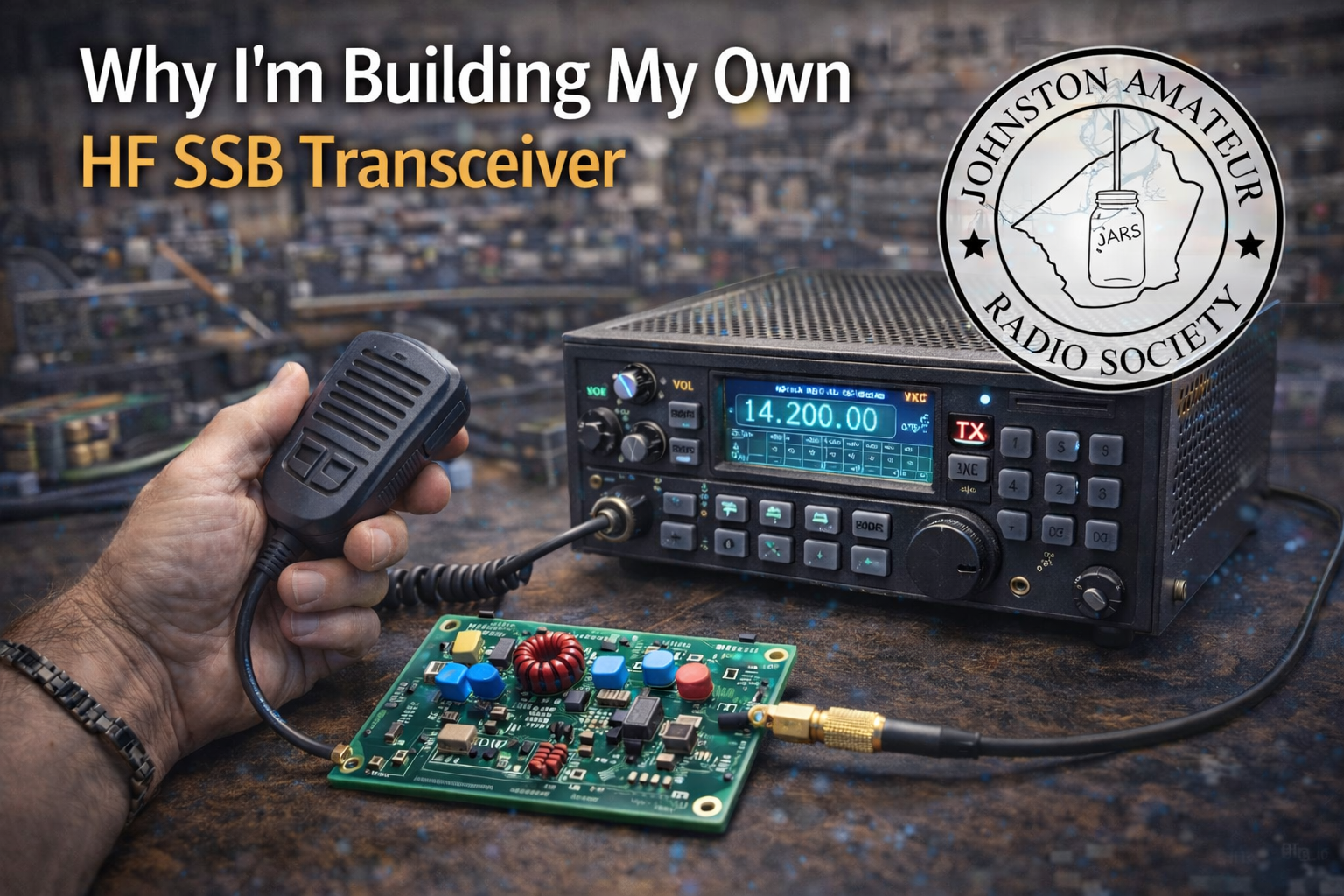
Every radio operator has a moment when the hobby stops being just about making contacts and starts being about understanding what makes those contacts possible. For me, that moment arrived this past year and when I renewed my FCC license. I used to be KJ4GIZ long ago and that call had expired.
I’ve been on the air for a while, but I realized something: I could operate an HF Single Side Band transceiver… yet I couldn’t explain one to others. Not really. Not down to the level where I could point to a signal path and say, “This is where the magic happens.”
So I decided to build one.
Not buy one. Not assemble a kit. Actually build one — stage by stage, circuit by circuit — until I could look at the finished radio and say two things with complete honesty:
- I finally understand how an SSB transceiver works.
- I made this myself.
That second part matters more than I expected. There’s something deeply satisfying about the idea that when someone hears me on the air, they’re hearing a signal that came from a radio I built with my own hands. It’s like catching a fish with a lure you carved yourself — the contact means more because you made the tool.
And yes, I’ve had help. Not from a mentor sitting next to me at a workbench, but from a different kind of companion: Microsoft Copilot. I’ve been using it to check circuit theory, explore design options, understand mixer behavior, and even sanity‑check my math. It’s been like having a patient, knowledgeable Elmer available 24/7 who never gets tired of my questions.
But the deeper question — the one I want to share with the JARS (Johnston County Radio Society) members — is this:
Why does this matter to my radio club?
Because this project isn’t just about me. It’s about us.
- It reminds us that amateur radio is still a hands‑on, experimental hobby. We don’t have to be just consumers of equipment. We can still be builders, tinkerers, experimenters — the very spirit amateur radio was founded on.
- It shows that learning the fundamentals is still exciting. Understanding how SSB works isn’t just academic. It makes you a better operator, a better troubleshooter, and a more confident communicator.
- It demonstrates that modern tools can empower old‑school skills. AI doesn’t replace the soldering iron. It just helps you understand what you’re soldering and why it matters.
- It has shown that electronic projects today can be controlled with microcomputers. Modern electronics has seriously advanced beyond my school education. This project gives me a reason to own the ARRL Radio Handbook
- It might inspire someone else in the club to build something too. Not necessarily a full transceiver — maybe a filter, a tuner, a preamp, or even a simple oscillator. But one person building something often sparks another.
In February, when I stand up at the club meeting, I won’t just be showing off a radio. I’ll be sharing a journey — one that blends curiosity, craftsmanship, and a little help from a digital friend.
And when I finally make that first contact on the air, I’ll be able to say:
“You’re coming through loud and clear… on a radio I built myself.”
My About page provides the background of my project, the Freedom7 HF Transceiver.
If this story resonates, comments are welcome. You can also reach me at david [at] kr4bad-dot-communications. no com
And if you believe understanding matters more than black boxes, you can subscribe to my WordPress https://kr4bad.com/?subscribe=1.
73 KR4BAD David


Leave a Reply to U.S. Electronics Manufacturing needs some Southern charm: Building a Powerful American HF Radio again – KR4BAD Amateur OperatorCancel reply